
This patient with lighter hair and documented Norwood Class III hair loss received 2,500 grafts using Vitruvian FUE™ to restore the hairline and frontal region. The case includes immediate postoperative evidence and a result photographed at approximately 12 months.
Approximately 12 Months After 2,500-Graft Vitruvian FUE™
This photograph documents the patient's appearance approximately 12 months after the 2,500-graft procedure.
Treatment was directed to the frontal scalp, with operative documentation identifying Zones 1 and 2 as the recipient areas.
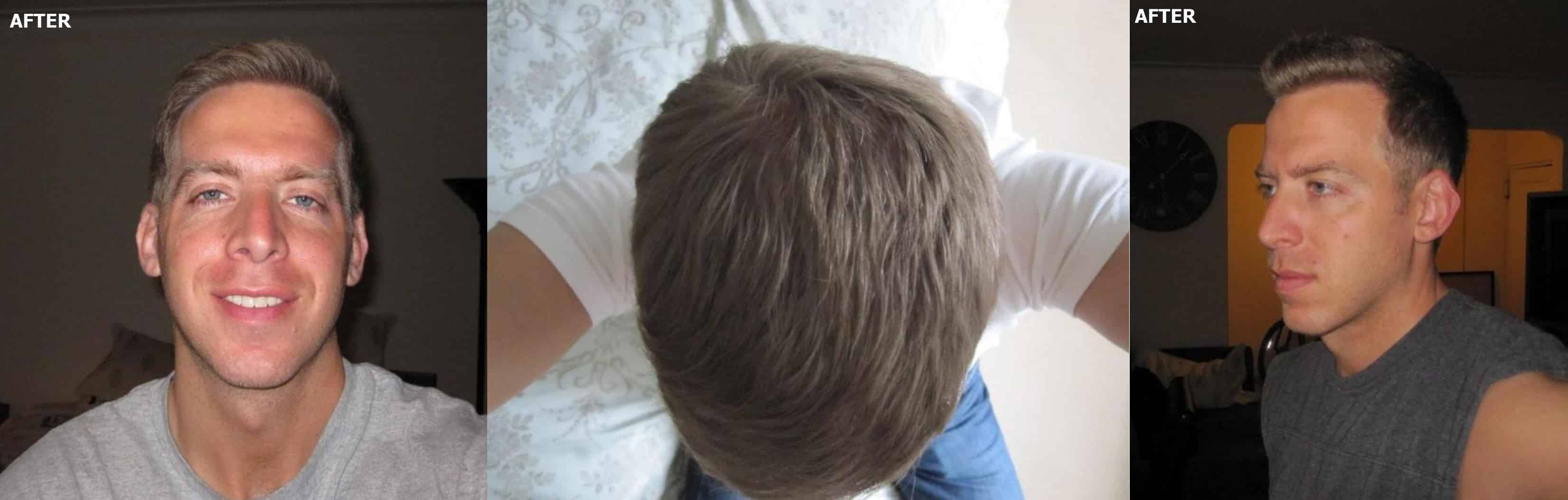
Norwood 3 Frontal Thinning With Minor Temple Recession
The patient presented with early frontal thinning and minor temporal recession.
His hair-loss pattern was documented as Norwood Class III and Alvi Armani Pattern 2, Class 3 .
The case also documents naturally lighter hair, making this a useful comparison with other 2,500-graft patients who have different hair characteristics and starting patterns.

2,500 Grafts Used to Reinforce the Hairline and Frontal Region
The procedure used 2,500 grafts with Vitruvian FUE™ to restore and reinforce the frontal hairline.
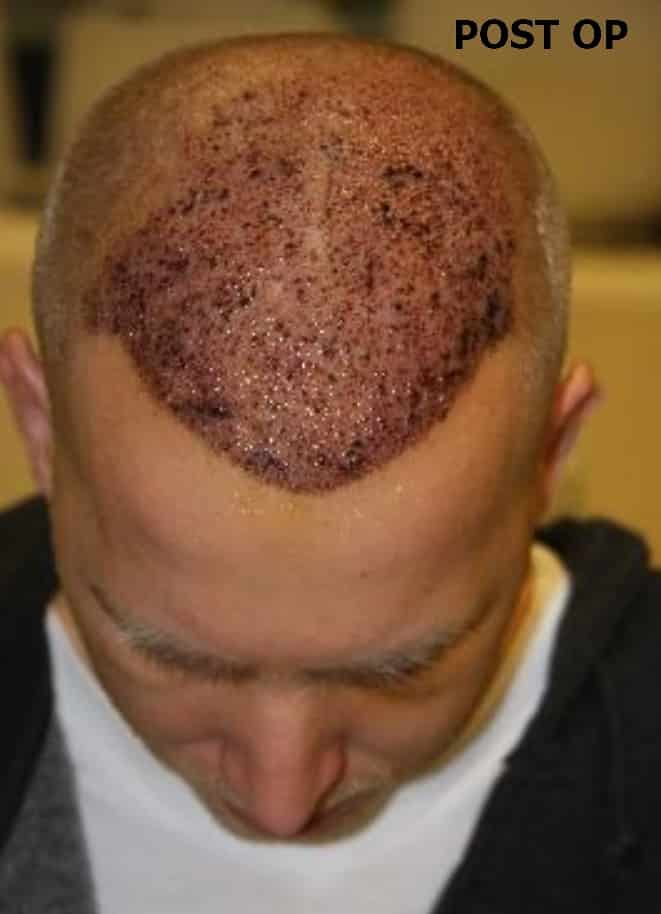
The postoperative record identifies Zones 1 and 2 as the treated recipient areas and notes that native hair remained within the region.
Zone 1
Treatment included the frontal hairline as part of the documented 2,500-graft plan.
Zone 2
Graft placement extended behind the hairline through the frontal region where native hair was still present.
Immediate Postoperative View of Zones 1 and 2
The immediate postoperative photograph documents graft placement through Zones 1 and 2 after the 2,500-graft procedure.
This image is particularly useful because it shows the recipient area before later hair growth changes its appearance.
frontal reinforcement
2,500 Grafts Can Be Used Within a Frontal Region That Still Has Native Hair
This case provides a documented example of 2,500 grafts being used for frontal restoration in a Norwood III patient who retained native hair within the treatment area.
That makes it different from a case in which the same graft count is used to reconstruct a substantially more depleted recipient area or to treat an entirely different region such as the crown.
The graft number should therefore be interpreted alongside the patient's starting pattern, treatment area and existing native hair rather than as a stand-alone measure of expected coverage.
Compare the Result With the Operative Treatment Area
The combination of baseline, immediate postoperative and approximately 12-month photography makes it possible to evaluate this result in the context of where the grafts were actually placed.
Hair color, lighting, styling and the amount of native hair present can also affect how coverage appears in photographs.
Questions About This 2,500-Graft FUE Case
How many grafts were transplanted?
The documented procedure used 2,500 FUE grafts.
What procedure was used?
The case documents treatment using Vitruvian FUE™.
What was the patient's hair-loss classification?
The patient was documented as Norwood Class III and Alvi Armani Pattern 2, Class 3.
Which areas were treated?
The postoperative record identifies Zones 1 and 2, corresponding to the hairline and frontal region.
Were the temples treated?
Minor temporal recession is documented in the patient's starting pattern, but a separate temple graft allocation is not documented. The operative record specifically identifies Zones 1 and 2.
Did the patient still have native hair in the treatment area?
Yes. The existing case documentation notes native hair within the frontal recipient area, with much of the treatment focused on reinforcement.
When was the result photographed?
The result photograph is documented at approximately 12 months after surgery.
Does lighter hair change how a result looks in photographs?
Hair characteristics and photographic conditions can affect the visual contrast between hair and scalp. This patient had naturally lighter hair, so his result should be evaluated as an individual case rather than used as a universal prediction for other patients.
Compare More Patient Evidence
Compare this frontal reinforcement case with other documented 2,500-graft treatment strategies and Alvi Armani patient results.
Your FUE Hair Transplantation Plan Is Individual
Graft count is only one part of planning. Your hair-loss pattern, treatment areas, existing native hair, donor resources and long-term goals all influence the appropriate approach.