
A documented FUE hair transplant performed by Dr. Baubac Hayatdavoudi at AlviArmani Beverly Hills for a 35-year-old patient with Norwood Class III frontal hair loss. The patient retained thinning hair through the frontal forelock but had substantial surrounding recession. A total of 3,115 grafts were transplanted in a single session, with the result shown here at one year.
3,115 Grafts for Norwood III Frontal Restoration
The treatment focused on reconstructing the frontal hairline around the patient's remaining native forelock. The available progression image documents the starting pattern, the immediate postoperative recipient area and the appearance approximately one year after surgery.
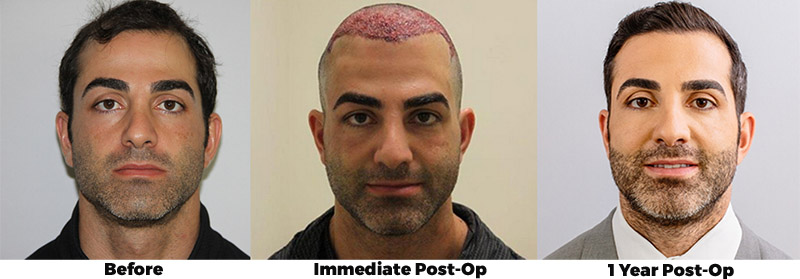
Norwood III Frontal Loss With a Remaining Forelock
The patient was 35 years old and presented with Norwood Class III hair loss concentrated through the frontal region.
He retained thinning native hair through the central frontal forelock, while the surrounding frontal and temporal areas had experienced more substantial recession.
The patient's goal was to restore a frontal hairline similar to the one he had only a few years earlier.
Reconstruct the Hairline Around Existing Native Hair
Dr. Baubac Hayatdavoudi transplanted 3,115 FUE grafts in a single session to reconstruct the frontal hairline and integrate the restoration with the patient's remaining frontal forelock.
The case documentation also notes strong donor density, providing relevant context for the surgical plan and the available donor resources at the time of treatment.
Frontal Hairline Reconstruction
The primary surgical objective was to rebuild the frontal hairline while incorporating the patient's existing hair through the central forelock.
Existing Forelock
Because native hair remained through the center of the frontal region, the transplant plan needed to connect newly transplanted areas with that existing hair rather than treating an entirely bald frontal scalp.
Donor Density and Native-Hair Maintenance
The case documentation describes the patient as having strong donor density, an important patient-specific factor when planning the 3,115-graft procedure.
Finasteride was also part of the strategy for maintaining the patient's existing native hair. This is particularly relevant because the patient still had thinning hair through the frontal forelock at the time of surgery.
Frontal Restoration From Above
The top-view comparison provides another perspective on the treated frontal region and how the restoration relates to the patient's existing hair behind it.

Close-Up View of the Reconstructed Hairline
The close-up photograph documents the appearance of the frontal hairline approximately one year after surgery.
Together with the frontal progression and top-view comparison, this provides several perspectives from which to evaluate the documented result.
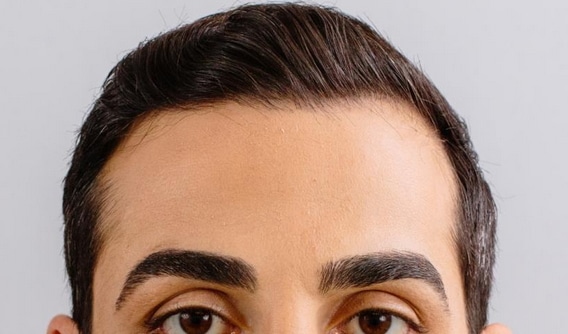
+ native forelock.
Existing Native Hair Changes the Planning Canvas
This case is useful within the approximately 3,000-graft group because the patient did not present with an entirely bare frontal region.
He retained thinning native hair through the frontal forelock, so the restoration needed to rebuild the surrounding hairline while integrating with existing hair.
The documented strong donor density and use of finasteride for native-hair maintenance also provide additional patient-specific context that differs from other cases with a similar graft total.
This case does not establish that every Norwood III patient requires approximately 3,100 grafts. The appropriate graft count depends on the treatment area, existing native hair, donor resources and the individual's restoration plan.
Understanding This 3,115-Graft Norwood III Case
How many grafts were transplanted?
Dr. Baubac Hayatdavoudi transplanted 3,115 FUE grafts in a single procedure.
How old was the patient?
The patient was 35 years old at the time of the documented case.
What was his hair-loss classification?
The patient was documented as having Norwood Class III hair loss concentrated in the frontal region.
Did the patient still have native hair in the frontal area?
Yes. He retained thinning native hair through the frontal forelock, with greater loss in the surrounding frontal region.
Who performed the procedure?
The procedure was performed by Dr. Baubac Hayatdavoudi at the AlviArmani Beverly Hills Clinic.
Was the donor area documented?
The original case documentation describes the patient as having strong donor density.
Was finasteride part of the patient's treatment plan?
Yes. Finasteride was documented as part of the strategy for preserving the patient's existing native hair.
When were the result photographs taken?
The documented result photographs shown on this page are approximately one year after surgery.
Does every Norwood III patient need about 3,100 grafts?
No. Classification alone does not determine graft requirements. Existing native hair, treatment-area size, donor resources and the individualized restoration strategy all influence the appropriate graft count.
Explore the Physician, Beverly Hills Clinic and More Results
Your Hair Restoration Plan Is Individual
Graft count is only one part of planning. Your hair-loss pattern, treatment areas, existing native hair, donor resources and long-term goals all influence the appropriate approach.