
A documented 3,081-graft FUE hair transplant for a patient in his mid-30s with Norwood 3 hair loss. The restoration addressed both the frontal hairline and temporal recession and was performed at the AlviArmani Beverly Hills Clinic. The result shown here is documented at 12 months.
3,081 Grafts for Hairline and Temporal Restoration
The patient's primary concerns were his frontal hairline and recession through the temporal regions. A total of 3,081 grafts were transplanted using FUE harvesting to address those areas.
The available comparison documents the patient's preoperative appearance and his result approximately 12 months after surgery.
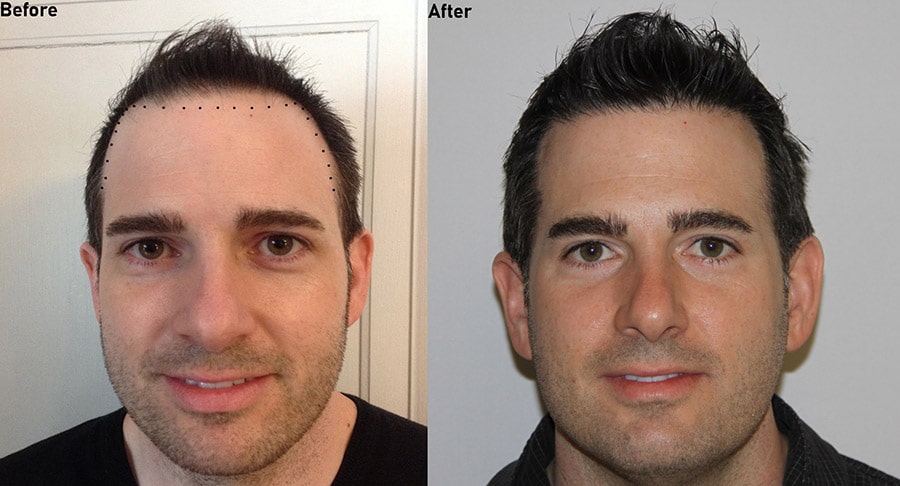
Norwood 3 Hair Loss With Hairline and Temporal Recession
The patient was in his mid-30s and presented with a documented Norwood 3 pattern. His primary concerns were the shape of his frontal hairline and recession through both temporal regions.
Although the documented pattern was not among the more advanced Norwood classifications, the recession affected the frontal framing of the face and became the focus of the surgical plan.
Restore the Hairline While Advancing the Temporal Region
AlviArmani developed a treatment plan using 3,081 FUE grafts to address the patient's hairline and temporal recession.
Temporal restoration creates a different design challenge than treating the central hairline alone. Hair direction and angle are important considerations when transplanted hair is used to reconstruct the temporal region and connect it with the frontal hairline.
Hairline Restoration
The frontal component of the procedure addressed the patient's dissatisfaction with the existing hairline and formed part of the broader frontal restoration.
Temporal Restoration
The treatment also addressed recession through the temporal regions, requiring attention to how transplanted hair transitioned from the temples into the frontal hairline.
Medical Therapy Was Also Recommended
In addition to the surgical restoration, AlviArmani physicians recommended a regimen of finasteride and minoxidil to help maintain the patient's existing native hair.
The available case documentation establishes that these medications were recommended. It does not establish adherence to the regimen or attribute the surgical result shown here to medical therapy.
Hairline and Temple Restoration at One Year
At approximately 12 months after surgery, the available comparison shows the appearance of the reconstructed frontal hairline and temporal regions.
Because the case includes a combined before-and-after image rather than a larger standardized photographic series, the result should be evaluated using the evidence actually available on this page.
temporal recession.
Similar Graft Counts Can Address Different Frontal Patterns
This case adds a useful comparison to the broader 3,000-graft result group because temporal recession was a significant component of the treatment plan.
Other patients receiving approximately 3,000 grafts may have those grafts concentrated farther through the frontal scalp, extended into the mid-scalp, directed toward a central forelock, or used as one stage of a larger restoration.
Here, the documented priorities were the hairline and temporal regions in a patient with Norwood 3 hair loss.
This case does not establish that every Norwood 3 patient requires 3,081 grafts. Graft requirements depend on the size of the treatment area, donor resources, existing native hair and the individual's restoration goals.
Understanding This 3,081-Graft Norwood 3 Case
How many grafts were transplanted?
The documented procedure used 3,081 grafts harvested using FUE.
What was the patient's hair-loss classification?
The patient was documented as having Norwood 3 hair loss.
Which areas were treated?
The treatment plan addressed the frontal hairline and temporal recession.
How old was the patient?
The patient was in his mid-30s at the time of the documented case.
Were finasteride and minoxidil part of the plan?
AlviArmani physicians recommended finasteride and minoxidil to help maintain the patient's existing hair. The available documentation confirms the recommendation but does not establish ongoing use.
Where was the procedure performed?
The procedure was performed at the AlviArmani Beverly Hills Clinic in 2018.
When were the result photographs taken?
The documented after appearance is approximately 12 months after the FUE procedure.
Does every Norwood 3 patient need about 3,000 grafts?
No. Norwood classification alone does not determine graft requirements. Treatment-area size, donor resources, existing native hair and restoration priorities all influence the appropriate plan.
Explore the Team, Beverly Hills Clinic and More Results
Your Hair Restoration Plan Is Individual
Graft count is only one part of planning. Your hair-loss pattern, treatment areas, existing native hair, donor resources and long-term goals all influence the appropriate approach.