
What can approximately 2,500 hair grafts accomplish? Compare documented AlviArmani patient evidence to see how similar graft counts can be used for different treatment areas and restoration strategies.
What Does a 2,500-Graft Hair Transplant Look Like?
There is no single appearance for a 2,500-graft hair transplant. Graft count tells you how many follicular units were transplanted, but it does not tell you where those grafts were placed or how large an area was treated.
Approximately 2,500 grafts may be concentrated within the hairline and frontal region, distributed across a broader recipient area, or used for another selected treatment area depending on the patient's individual plan.
Recipient-area size, existing native hair, donor resources, hair characteristics and restoration goals all influence what a given graft count can accomplish.
2,500-Graft FUE for the Frontal and Temporal Regions
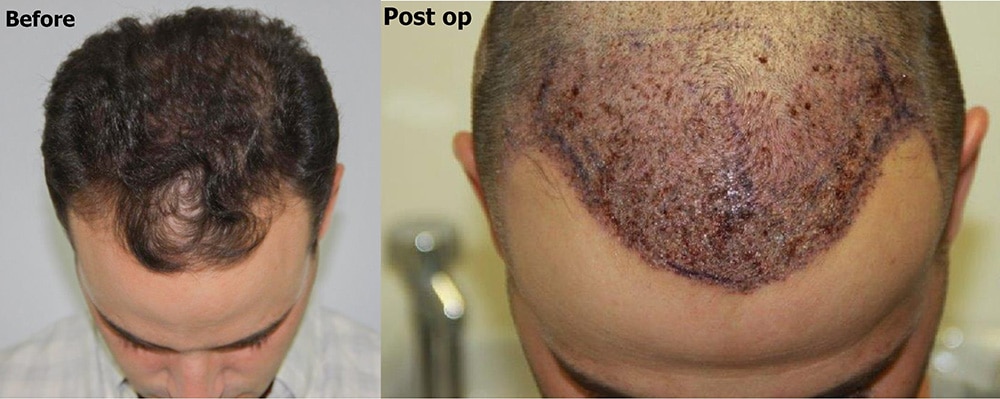
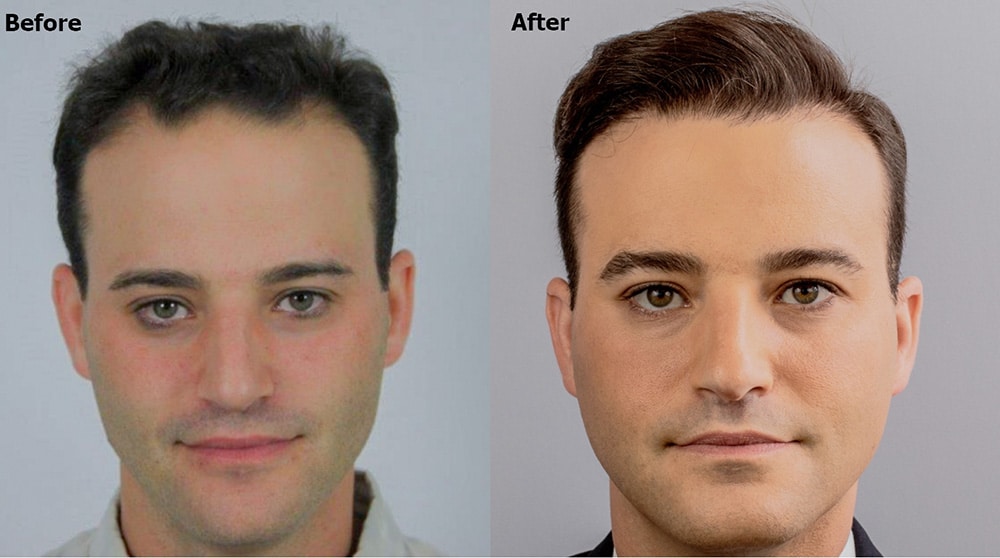
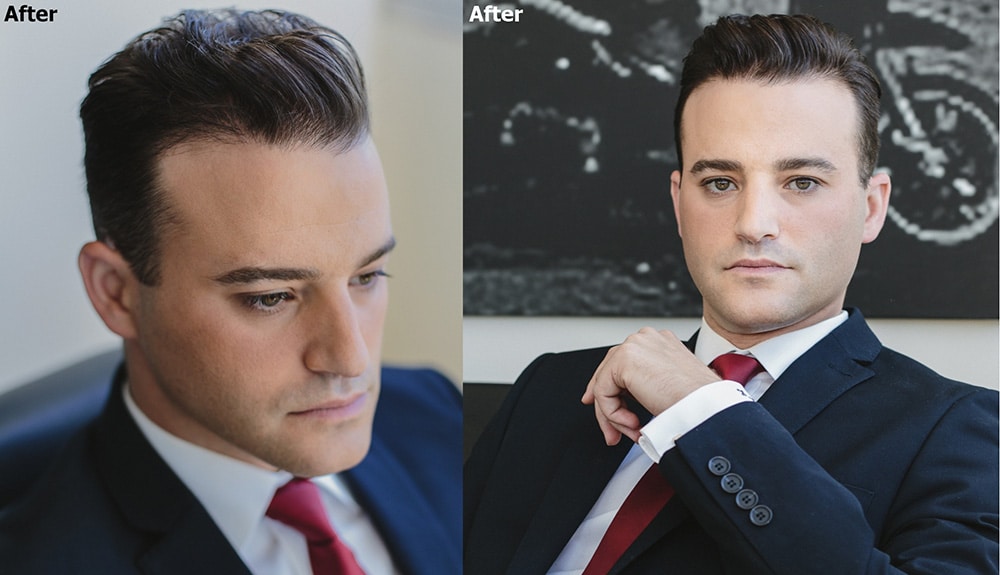
This patient received 2,500 FUE grafts at AlviArmani Beverly Hills to restore the frontal and temporal regions.
He presented with a documented Norwood Class III hair-loss pattern, corresponding to AlviArmani Pattern 2, Class 4/5.
The procedure was documented as Vitruvian FUE™ .
2,500-Graft FUE Hair Transplant Results
The original photography from this case documents the patient's treatment and postoperative appearance following the 2,500-graft frontal and temporal restoration.

A Frontal-Focused 2,500-Graft Restoration
In the featured patient, the documented recipient areas were the frontal and temporal regions.
This makes the case an example of a focused use of 2,500 grafts rather than a treatment plan extending through every region of the scalp.
Frontal Restoration
The frontal region was one of the specifically documented treatment areas for this procedure.
Temporal Restoration
The temporal regions were also included in the documented 2,500-graft treatment plan.
More Results in the 2,500–2,999 Graft Range
These documented patient cases show how graft counts in the 2,500–2,999 range can be used across different treatment areas, starting patterns and restoration plans.
Exact 2,500-graft cases are shown first, followed by nearby graft counts for additional comparison. The exact graft count and documented treatment details are identified for each patient.
≠ one coverage plan
How Much Coverage Can 2,500 Hair Grafts Provide?
There is no fixed amount of scalp that 2,500 grafts will cover.
A patient with a smaller recipient area may have grafts concentrated within that region, while another patient may distribute a similar graft count across a broader area.
Existing native hair also changes the planning context. Placing grafts into an area that still contains native follicles is different from rebuilding an area with substantially less existing coverage.
Recipient-area size, donor resources, existing native hair, hair characteristics and restoration goals should therefore be considered alongside graft count.
Is 2,500 Grafts a Lot — and Is It Enough?
Whether 2,500 grafts is a large or sufficient number depends on what the procedure is intended to accomplish.
For one patient, approximately 2,500 grafts may support a focused hairline or frontal restoration. For another patient with a larger recipient area, the same number may need to be distributed more broadly or may represent only part of a larger restoration strategy.
The useful question is therefore not whether 2,500 grafts is universally “enough,” but whether that graft supply is appropriate for the patient's recipient area and long-term treatment plan.
What Does Harvesting 2,500 Grafts Mean for the Donor Area?
A graft count represents donor resources being used as well as recipient-area coverage being created.
The significance of harvesting approximately 2,500 grafts depends on the individual's available donor resources and long-term restoration strategy. Donor planning should therefore be considered together with recipient-area goals rather than treating the graft number as an isolated target.
How Much Does a 2,500-Graft Hair Transplant Cost?
There is not one universal price determined solely by the 2,500-graft number. Hair transplant pricing depends on the procedure and individualized surgical plan.
The first step is determining the appropriate treatment area and graft requirement rather than selecting a graft count based on price alone.
Compare More Than the 2,500-Graft Number
Before-and-after photographs are most useful when the graft count can be interpreted alongside the patient's starting pattern, treatment areas and follow-up timing.
Lighting, styling, camera angle and whether the hair is wet or dry can also materially affect how coverage appears in photographs.
Questions About 2,500-Graft Hair Transplants
What does 2,500 grafts look like?
There is no single appearance. The result depends on recipient-area size, where the grafts are placed, existing native hair, hair characteristics and the patient's starting pattern.
How much coverage can 2,500 grafts provide?
Coverage is not fixed by graft count. Approximately 2,500 grafts may be concentrated within a focused area or distributed across a broader recipient region depending on the individual treatment plan.
Is 2,500 grafts a lot for a hair transplant?
The number needs to be interpreted in relation to the treatment area and donor resources. A 2,500-graft procedure can represent a substantial restoration, but the same graft count can be used very differently from one patient to another.
Is 2,500 grafts enough for a hair transplant?
It can be appropriate for some treatment plans, but there is no universal graft requirement. The appropriate number depends on recipient-area size, donor resources, existing native hair, hair characteristics and restoration goals.
Can 2,500 grafts restore a hairline and temples?
Yes, in an appropriate treatment plan. The featured patient on this page received 2,500 FUE grafts to restore the frontal and temporal regions. That does not mean every patient with similar goals requires the same graft count.
Can around 2,500 grafts be used for the crown?
They can be in an appropriately selected treatment plan. The appropriate graft requirement depends on the size and characteristics of the recipient area and the patient's broader restoration strategy. AlviArmani also documents a nearby 2,588-graft crown-specific patient case.
Are 2,500 grafts the same as 2,500 hairs?
No. A graft is a follicular unit and may contain more than one hair. The number of hairs represented by 2,500 grafts therefore depends on the follicular-unit composition.
How much does a 2,500-graft hair transplant cost?
Hair transplant pricing depends on the procedure and individualized treatment plan rather than one universal price attached to the number 2,500. Review current AlviArmani hair transplant pricing.
Compare Results and Build an Individualized Graft Plan
Patient cases show how similar graft counts can be used differently. An individualized evaluation is required to determine the appropriate treatment area and graft plan.
Your Hair Restoration Plan Is Individual
Graft count is only one part of planning. Your hair-loss pattern, treatment areas, existing native hair, donor resources and long-term goals all influence the appropriate approach.