
Do You Have To Shave Your Head For A Hair Transplant? Hair Transplant Myths

Key Highlights
- Having to shave your entire head for a hair transplant is largely a myth.
- Modern options include unshaven, partially shaved, and minimal-shave FUE procedures.
- Executive Line™ No-Shave FUE hides the donor area completely for maximum discretion.
- Executive Buzz™ FUE leaves the top unshaved while providing full donor access.
- Vitruvian FUE™ delivers the highest graft volumes and ultimate design precision.
- No-shave options are ideal for professionals seeking privacy during the recovery process.
- The best approach depends on your degree of hair loss, donor capacity, lifestyle, and aesthetic goals.
Introduction
One of the most common questions people ask before getting a hair restoration procedure is:
“Do I have to shave my head?”
For many, the idea of walking into work or social events with a buzzed scalp feels intimidating. The thought of a dramatic change—especially when you’re already self-conscious about your appearance—can make the entire process feel overwhelming.
The good news is that modern hair transplantation has evolved beyond the full-shave requirement. With innovations in follicular unit extraction and Alvi Armani’s specialized no-shave techniques, you now have options that let you maintain your existing hairstyle while undergoing world-class restoration.
Whether you want a completely invisible process or you’re open to a small donor buzz, there is a solution that fits your needs.
Why Do People Think You Have to Shave Your Head?
This belief comes from the early days of FUE and FUT, when surgeons needed complete visibility to perform precise work. With long hair in the way, extracting individual hair follicles was harder, and grafts were more likely to be transected (damaged during removal).
Historical Benefits of Full Shave Hair Transplant
- A clear field of view
- Easier identification of strong follicles
- Faster extraction times
- Lower risk of errors
- Better hygiene during and after surgery
These reasons are still valid for certain session sizes. However, advancements in tools, technique, and surgical skill now allow expert teams to perform highly detailed work through longer surrounding hair—something that simply wasn’t possible 10–15 years ago.
That’s where unshaven and partially shaved FUE techniques come in.
Myth vs. Reality: A Full Shave Is NOT Always Necessary
The assumption that all hair transplants require a full head shave is outdated. Today, you can choose between:
- Fully unshaven methods
- Minimal micro-trim donor methods
- Partial donor buzz
- Or full-shave sessions for maximal graft volume
These options allow your provider to tailor the procedure to your lifestyle, degree of hair loss, and cosmetic goals.
Many patients come to Alvi Armani concerned about privacy. With techniques like Executive Line™ No-Shave FUE, the surrounding longer hair hides virtually all early signs of the procedure. This makes hair transplant recovery significantly more discreet.
You can return to work or social life almost immediately without anyone knowing what you’ve had done.

Considering No-Shave FUE?
Most patients don’t need a full shave. Learn which option offers the discretion, density, and design precision you’re looking for.
Free ConsultationShaved vs. Unshaven Hair Transplant Options
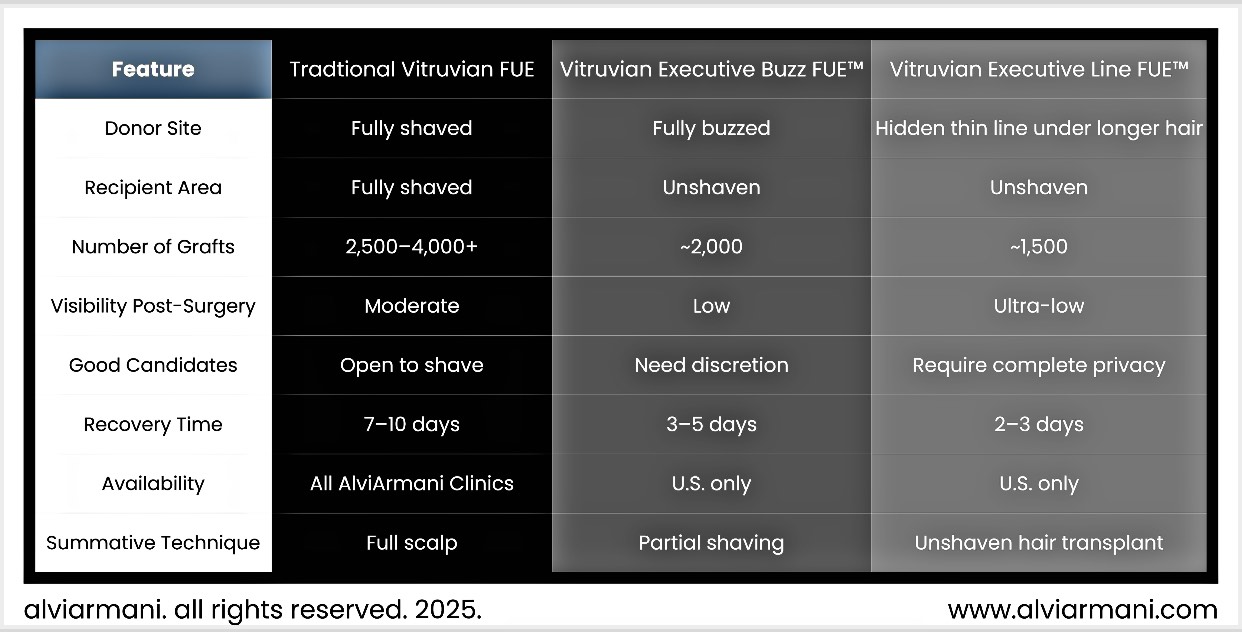
Modern hair transplantation offers a spectrum of shaving requirements. Here’s a clearer breakdown of how each one works and who it benefits.
Comparison of Techniques
| Technique | Shaving Required | Scar | Best For |
|---|---|---|---|
| Executive Line™ No-Shave FUE | Hidden micro-trim only | None | Maximum privacy; small–medium sessions |
| Executive Buzz™ FUE | Donor buzz only | None | Medium–large sessions without shaving top hair |
| Vitruvian FUE™ | Full donor + recipient shave | None | Maximum density, precision, mega-sessions |
Alvi Armani’s Advanced No-Shave & Partial-Shave Approaches

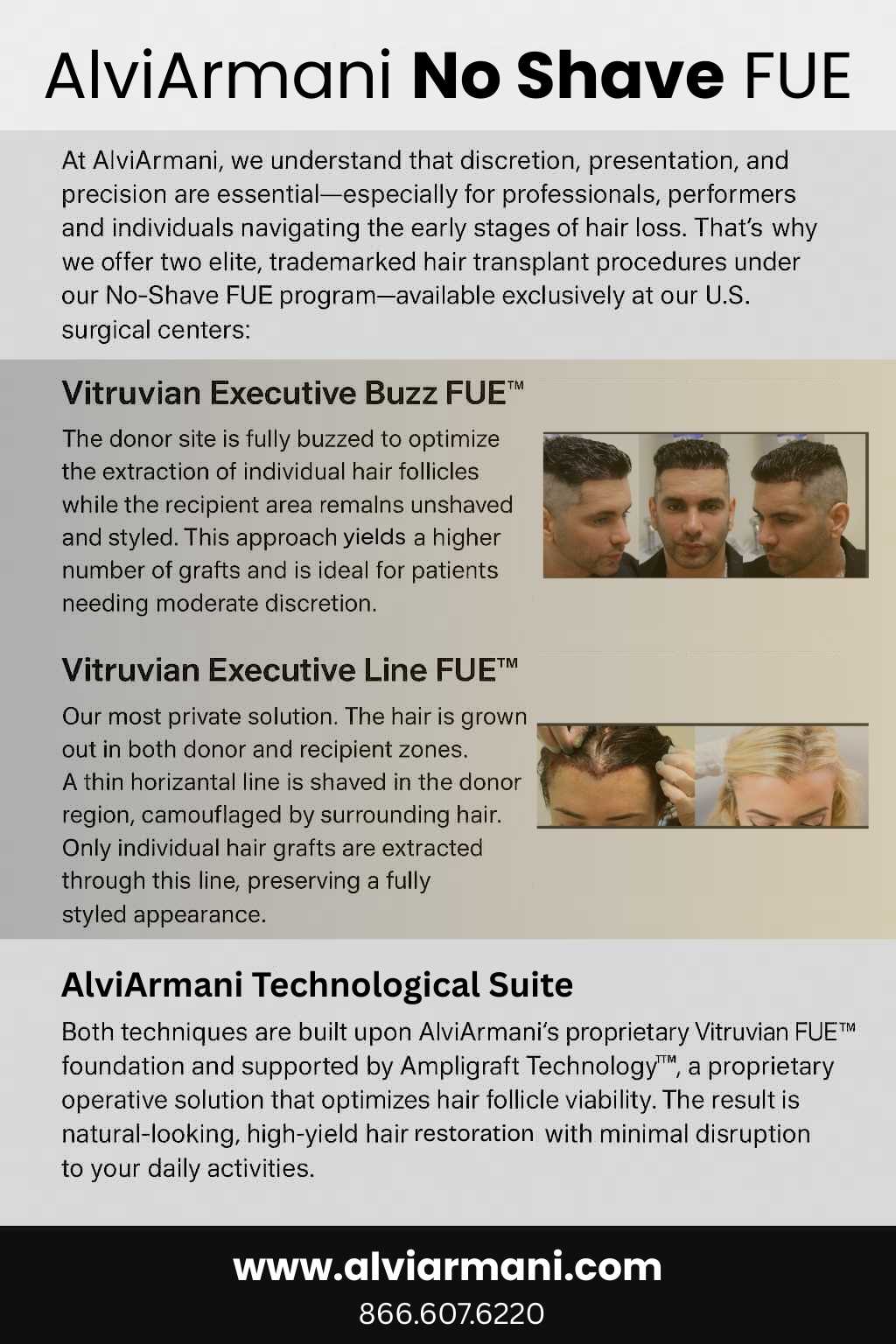
Executive Line™ No-Shave FUE (True No-Shave)
During this procedure, only a thin horizontal line in the donor region is micro-trimmed—completely hidden by your longer hair. The top and sides remain uncut.
Benefits include:
- No visible sign of surgery
- Seamless blending with your existing hair
- Discreet healing with minimal lifestyle interruption
- Ideal for public-facing professions
- Natural integration with new hair growth

Executive Buzz™ FUE (Donor-Only Trim)
The donor area is buzzed for a cleaner, faster harvest, while all your top hair remains long. This approach allows for a larger graft count while still maintaining a styled look in social and professional settings.
Perfect for:
- Medium-to-large sessions
- Patients who prefer discretion on top
- Those comfortable with a short donor area

Female No-Shave FUE
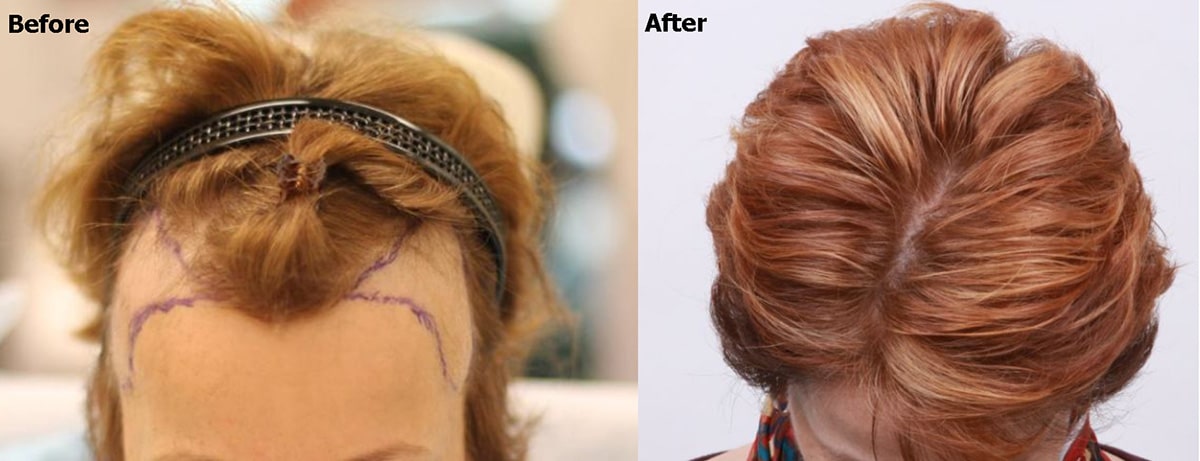
Women can undergo restoration without altering their hairstyle. The donor and recipient areas are navigated with precision, using micro-extraction around existing long hair.
Excellent for:
- Forehead lowering
- Part-line density
- Crown diffusing
- Postpartum hair loss patterns
Why Some Clinics Still Recommend Shaving
Even with modern methods, there are practical reasons some clinics may still encourage shaving:
1. Visibility and Precision
A shaved scalp provides full sightlines for accurate angle control and graft placement, which is crucial for large sessions.
2. Faster Extraction
Working through long hair is significantly more labor-intensive. A shaved donor area speeds up the entire extraction process.
3. Better Hygiene
A clean surface is easier to keep disinfected and reduces post-op crusting in dense areas.
4. Higher Graft Capacity
When thousands of grafts are needed, shaving maximizes efficiency without compromising quality.
5. Lower Risk of Tangling
Long hair can interfere with newly implanted grafts.
But remember—shaving is a technical preference, not a medical requirement for most patients.
Benefits of Unshaven Hair Transplants
Unshaven or minimal-shave procedures offer a range of advantages that are especially meaningful for modern lifestyles.
Discreet Recovery
Your natural hair conceals:
- Donor micro-extraction points
- Redness
- Scabs
- Swelling
Minimal Downtime
Most patients return to work or social events within days because there is nothing visibly different about their hairstyle.
No Drastic Change to Your Appearance
Your surrounding hair blends with the treated zones, helping you maintain your look while the implanted grafts mature into new hair.
Confidence During the Healing Process
You have control over who knows you’ve had hair restoration surgery, and you can choose the timing of when (or if) to share it.
Limitations of No-Shave and Partial-Shave Procedures
While the benefits are substantial, it’s important to understand realistic limitations:
- Limited graft volume per session (especially true no-shave)
- Higher cost due to increased surgical time
- Not ideal for advanced Norwood patterns
- Requires a highly experienced team to achieve the best results
At Alvi Armani, even during no-shave extractions, transection rates remain sub-1%, but achieving this standard requires more time and meticulous technique.
How to Know Which Option Is Right for You
Choosing a shave or no-shave method depends on:
- The number of grafts required
- Your pattern and progression of hair loss
- The amount of privacy you want
- Your hairstyle and hair length
- Whether you need a mega-session or a small touch-up
- Your long-term goals for density and design
Quick Guide
- Max privacy: Executive Line™ No-Shave FUE
- High grafts + styled top: Executive Buzz™
- Maximum transformation: Vitruvian FUE™ full shave
- Women: Female No-Shave FUE
Ready to Take the Next Step?
Explore your no-shave, partial-shave, or full FUE options with an expert consultation.
Book Your Free ConsultationConclusion
You do not need to shave your head to undergo a modern hair restoration procedure. With advanced Alvi Armani options like Executive Line™, Executive Buzz™, and Vitruvian FUE™, patients can undergo surgery with privacy, control, and confidence—choosing the method that best fits their lifestyle and goals.
Whether you prefer a completely unshaven approach or a full-shave session for higher density, today’s hair transplant procedures offer flexibility at every level. A consultation with an experienced provider will help determine the technique that delivers your best long-term result.
Frequently Asked Questions
Can I get a hair transplant with absolutely no shaving?
Yes. With Executive Line™ No-Shave FUE, only a micro-strip in the donor area is trimmed and hidden beneath longer hair. The top remains untouched.
Will a no-shave transplant affect healing or final results?
Not when performed by a skilled team. Healing looks more discreet, and long-term growth is identical to shaved procedures.
Are no-shave FUE procedures riskier?
They’re more technically demanding, but not riskier when performed by experts. The main challenge is navigating extraction around longer hair.
Why are no-shave procedures more expensive?
They take longer, require more precision, and involve intricate extraction through existing hair—especially when maintaining sub-1% transection rates.
Is shaving better for large sessions?
Yes. Full-shave Vitruvian FUE™ is ideal for bigger transformations because it allows the surgeon to work faster, more precisely, and with more grafts.