
Alvi Armani • Research Institute White Paper
Botanical Modulation of the Hair Growth Cycle
Molecular and cellular mechanisms of plant-derived compounds in follicular regeneration, growth signaling, and long-term hair follicle health.
Summary
The human hair follicle is a regenerative mini-organ governed by coordinated molecular signaling. This white paper reviews how botanical compounds may influence follicular biology by modulating several pathways at once, including Wnt/β-catenin, Sonic hedgehog, BMP/Noggin, FGF, androgen signaling, inflammatory cascades, oxidative stress, prostaglandin balance, and microvascular support.
Rather than treating hair growth as a single switch, this framework presents follicular health as a network problem: multiple pathways interact to determine whether a follicle sustains anagen, regresses, or miniaturizes.
Key Takeaways
- Hair loss is systems-level: follicular miniaturization often reflects converging androgenic, inflammatory, oxidative, vascular, and metabolic disruptions.
- Growth signaling is coordinated: Wnt/β-catenin, Shh, BMP/Noggin, FGF, VEGF, and IGF-1 help regulate anagen entry, maintenance, and regression.
- Botanicals are multi-target: phytosterols, polyphenols, flavonoids, terpenoids, and alkaloids may influence multiple domains of follicular biology.
- Synergy matters: polybotanical systems are best understood through network pharmacology rather than a single-molecule framework.
Who This Is For
- Patients: to understand why scalp and follicle health are biologically complex.
- Clinicians: to review a pathway-based framework for botanical modulation.
- Consultants/teams: to explain hair growth support without overstating claims.
- Researchers: to connect phytochemistry, follicular signaling, and systems biology.
How to Use This White Paper
- Start with the hair cycle: anagen, catagen, telogen, and exogen are controlled by epithelial–mesenchymal signaling.
- Map the disruption: DHT, inflammation, oxidative stress, prostaglandins, and reduced VEGF can converge on follicular regression.
- Evaluate botanical synergy: multiple plant-derived compounds may support several pathway domains simultaneously.
Note: This page is a summary layer; the full PDF contains the complete scientific discussion, figures, and references.
Figures
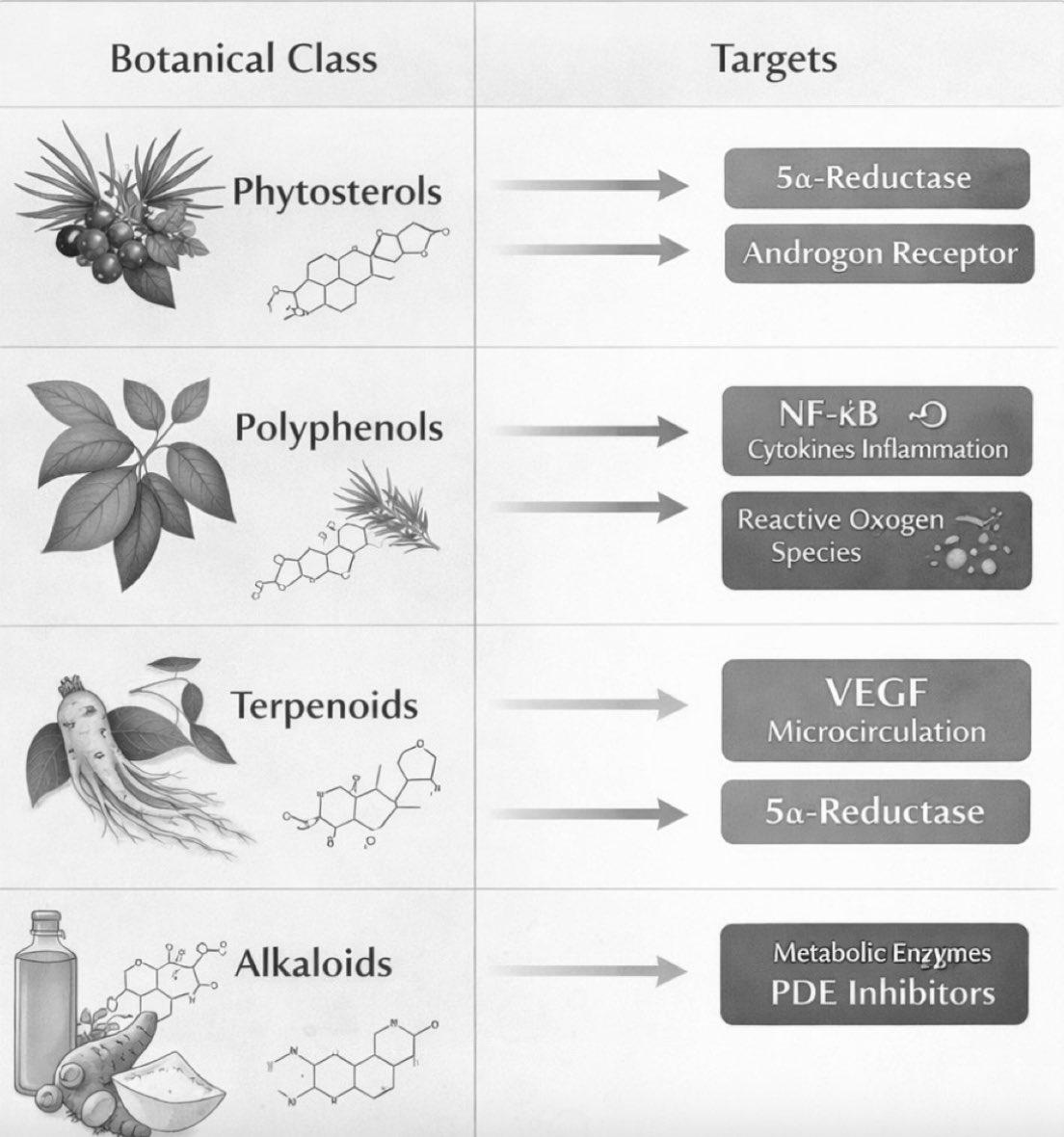
Botanical Compounds Mapped to Molecular Targets
- Phytosterols: 5α-reductase and androgen receptor pathway support
- Polyphenols: NF-κB, cytokines, inflammatory tone, and reactive oxygen species
- Terpenoids: VEGF, vascular tone, microcirculation, and 5α-reductase-associated pathways
- Alkaloids: metabolic enzymes, PDE-associated pathways, and prostaglandin balance
- Polybotanical systems: distributed support across multiple follicular signaling domains
- Network model: hair growth support is best understood as multi-pathway modulation rather than a single-target mechanism
The central theme of the paper is that botanicals may be most relevant when understood as distributed pathway modulators, not as single-target interventions.
Molecular Architecture of Hair Follicle Cycling
Hair follicle regeneration depends on local stem cell activation, dermal papilla signaling, growth-factor support, inflammatory tone, and vascular-metabolic conditions. The pathways below act together to regulate whether a follicle remains quiescent, enters anagen, or progresses toward regression.
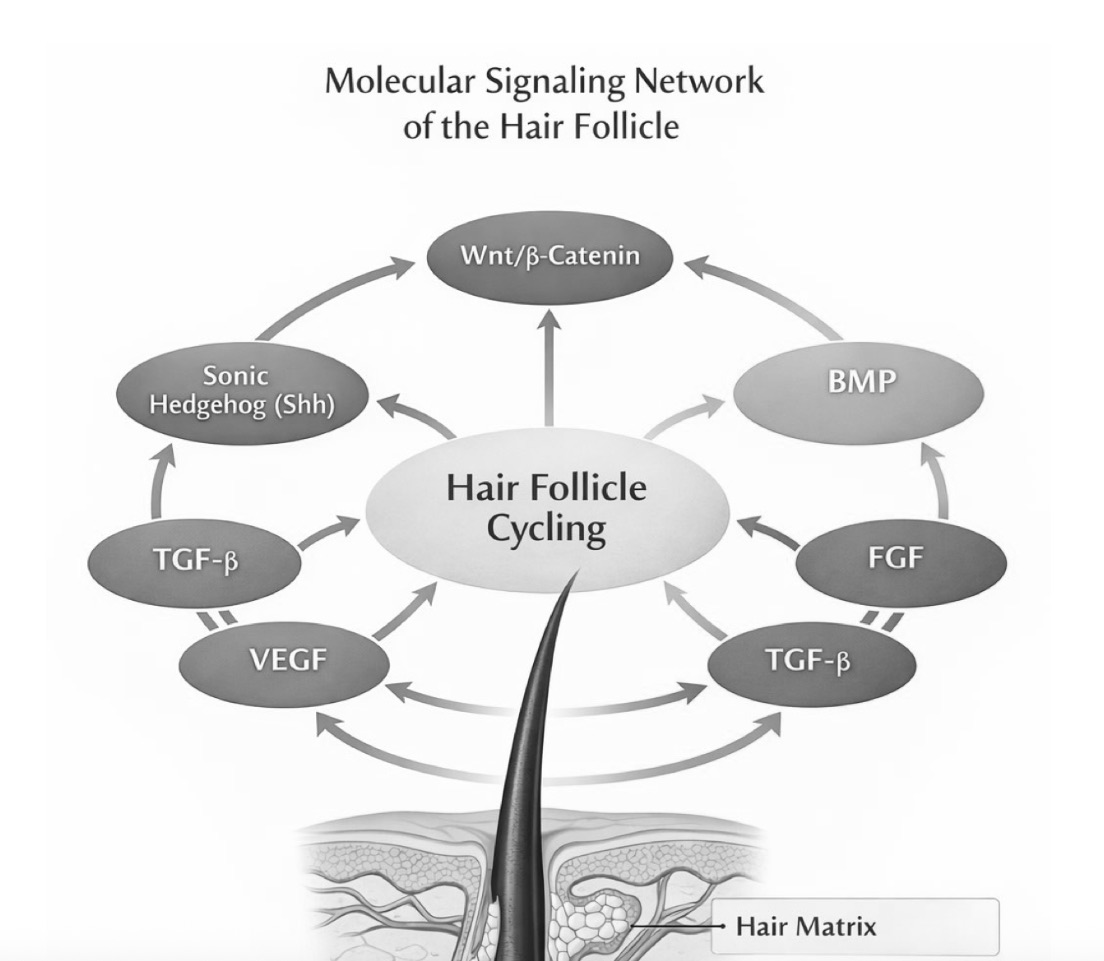
Wnt/β-Catenin
Central to telogen-to-anagen transition, stem cell activation, and hair shaft production.
Sonic Hedgehog
Supports matrix proliferation, follicular morphogenesis, and dermal papilla identity.
BMP / Noggin
BMP helps maintain rest; Noggin counterbalances BMP signaling to permit anagen onset.
FGF, VEGF, and IGF-1
Growth-factor and vascular support help sustain the energy demands of active follicles.
Botanical Modulation
Looking for a more practical, blog-style breakdown?
For a simplified, application-focused explanation of these same mechanisms, read the Origenere article on botanical hair growth pathways: Botanical Hair Growth Mechanisms.
Research Commentary
A companion LinkedIn post expands on the broader significance of botanical modulation, follicular physiology, and the evolving scientific conversation around hair restoration.
Pathogenesis of Hair Loss
- DHT-driven androgen receptor activation
- Chronic microinflammation and cytokine signaling
- Reactive oxygen species and mitochondrial stress
- Prostaglandin imbalance and premature catagen signaling
- Reduced VEGF, blood flow, and metabolic support
Potential Botanical Targets
- 5α-reductase and androgen pathway modulation
- NF-κB and pro-inflammatory cytokine suppression
- Antioxidant defense and redox stabilization
- VEGF and microvascular support
- Wnt/β-catenin and growth-factor-associated signaling
Full White Paper (PDF)
If the embedded PDF does not display on some mobile devices, use the Download or Open PDF button above.
Author
Charit Seneviratne, PhD — Biomedical scientist and Director of Research at the Alvi Armani Research Institute, with a scientific focus on follicular signaling networks, oxidative stress biology, phytochemistry, and systems-level approaches to tissue regeneration.
If the LinkedIn post does not load, view the post directly on LinkedIn .
Common Questions
Is this paper saying botanicals replace medical hair loss treatments?
No. The paper is a mechanistic review. Botanical compounds are discussed as pathway modulators and potential adjuncts within a broader follicular health framework.
Why does the paper focus on multiple pathways?
Hair follicle cycling depends on a network of androgenic, inflammatory, oxidative, vascular, metabolic, and growth-factor signals. A single-pathway explanation is often too narrow.
How should patients use this information?
Patients can use the paper to better understand the biology behind hair growth support, but individual treatment decisions should be made with a qualified medical professional.