
Alvi Armani • Research Institute White Paper
The Female Paradox in Hair Transplantation
Demand, Barriers, and the Future of Women in Surgical Hair Restoration
Summary
Women account for the vast majority of aesthetic procedure utilization globally, yet remain a small minority of patients undergoing surgical hair restoration. This white paper explains why that gap persists—even in the presence of common, clinically meaningful female hair loss—and argues that the largest drivers are upstream and modifiable.
Rather than framing underutilization as primarily “female complexity,” the paper presents a four-domain model (clinical determinants, psychosocial influences, structural factors, and informational asymmetry) and highlights the highest-yield interventions: better pathway capture, clearer candidacy frameworks, female-centered design training, and transparent education that helps patients reach evidence-based consultation earlier.
Key Takeaways
- The largest drop-off is upstream: awareness and pathway capture—not surgical feasibility—most strongly shapes utilization.
- Female patterns differ: diffuse miniaturization, donor variability, and mixed etiologies require structured evaluation.
- Hairline creation is often central: traction alopecia and temporal progression are common female surgical indications.
- Technique selection is contextual: FUE and FUT are tradeoffs shaped by styling priorities, donor strategy, and operator capability.
Who This Is For
- Patients: to understand candidacy, expectations, and how surgical planning differs in women.
- Clinicians: to improve diagnostic framing, donor mapping rigor, and counseling language.
- Referrers: to recognize when a surgical consult is appropriate alongside medical therapy.
- Teams: to align education, intake, and consult workflows around female-centered patterns.
How to Use This White Paper
- Start with the context: Figure 1 quantifies the utilization gap—women have high aesthetic utilization but low surgical hair restoration utilization.
- Understand the drivers: Figure 2 frames the four domains that explain underrepresentation (clinical, psychosocial, structural, informational).
- Locate the drop-off: Figure 3 shows where the pathway breaks down—upstream of consultation—where the most modifiable losses occur.
Note: This page is a summary layer; the full PDF contains the complete narrative synthesis, citations, and structured recommendations.
Figures
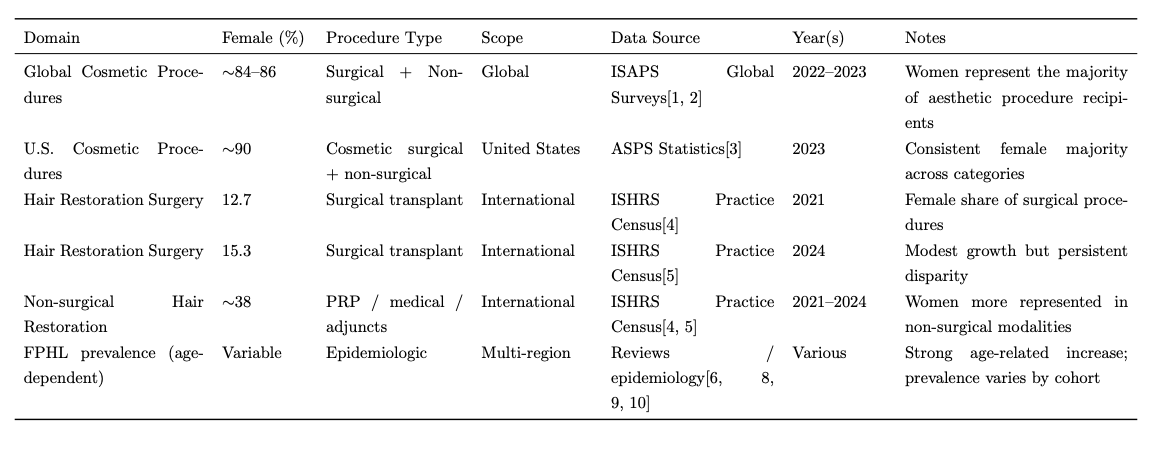
This figure anchors the paradox in measurable terms. The key point is not whether women experience hair loss—they do—but that surgical pathway capture remains disproportionately low relative to overall aesthetic engagement.
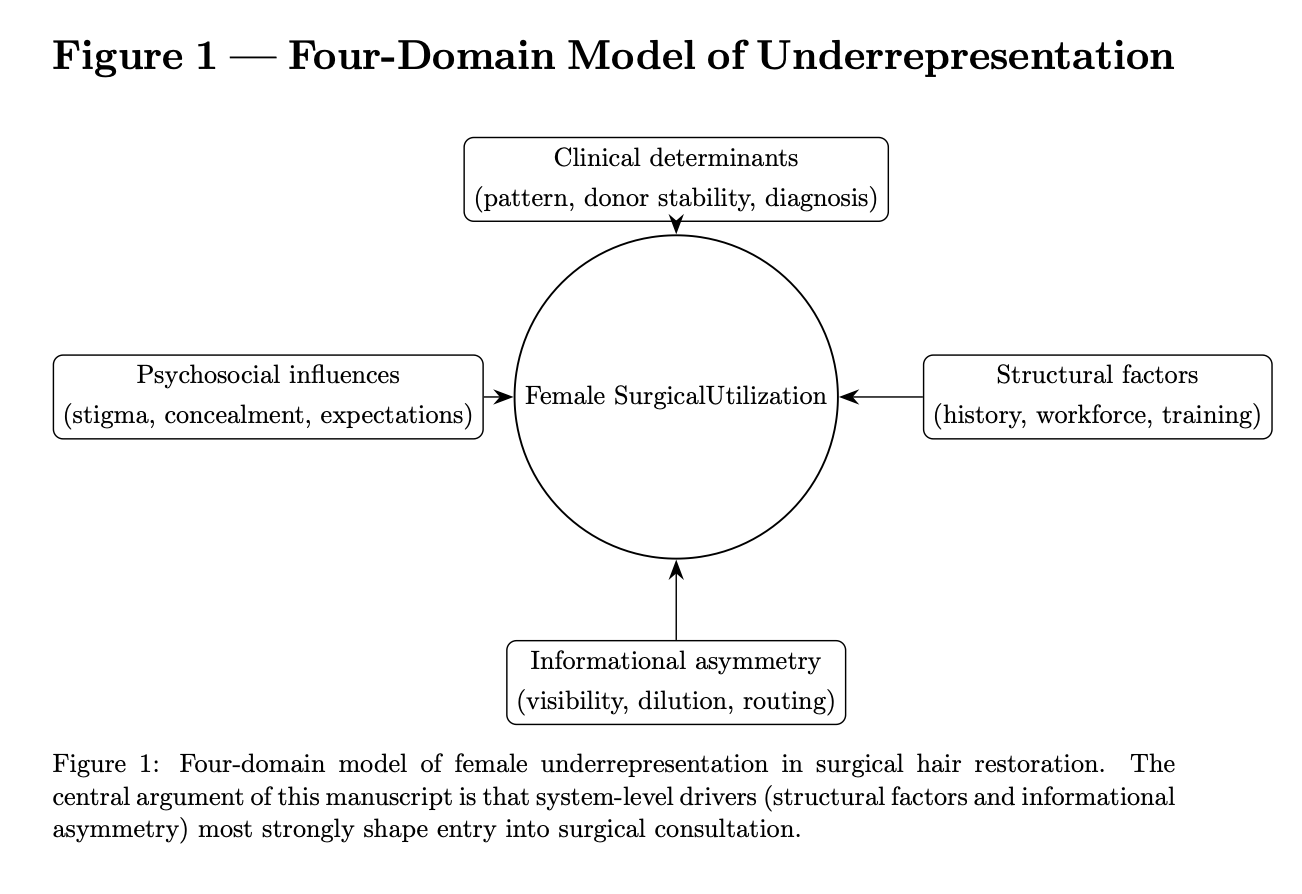
This model reframes the female hair transplant gap as a systems issue, not simply a clinical one. While clinical and psychosocial factors matter, structural and informational forces largely determine whether women reach an evidence-based surgical consultation.
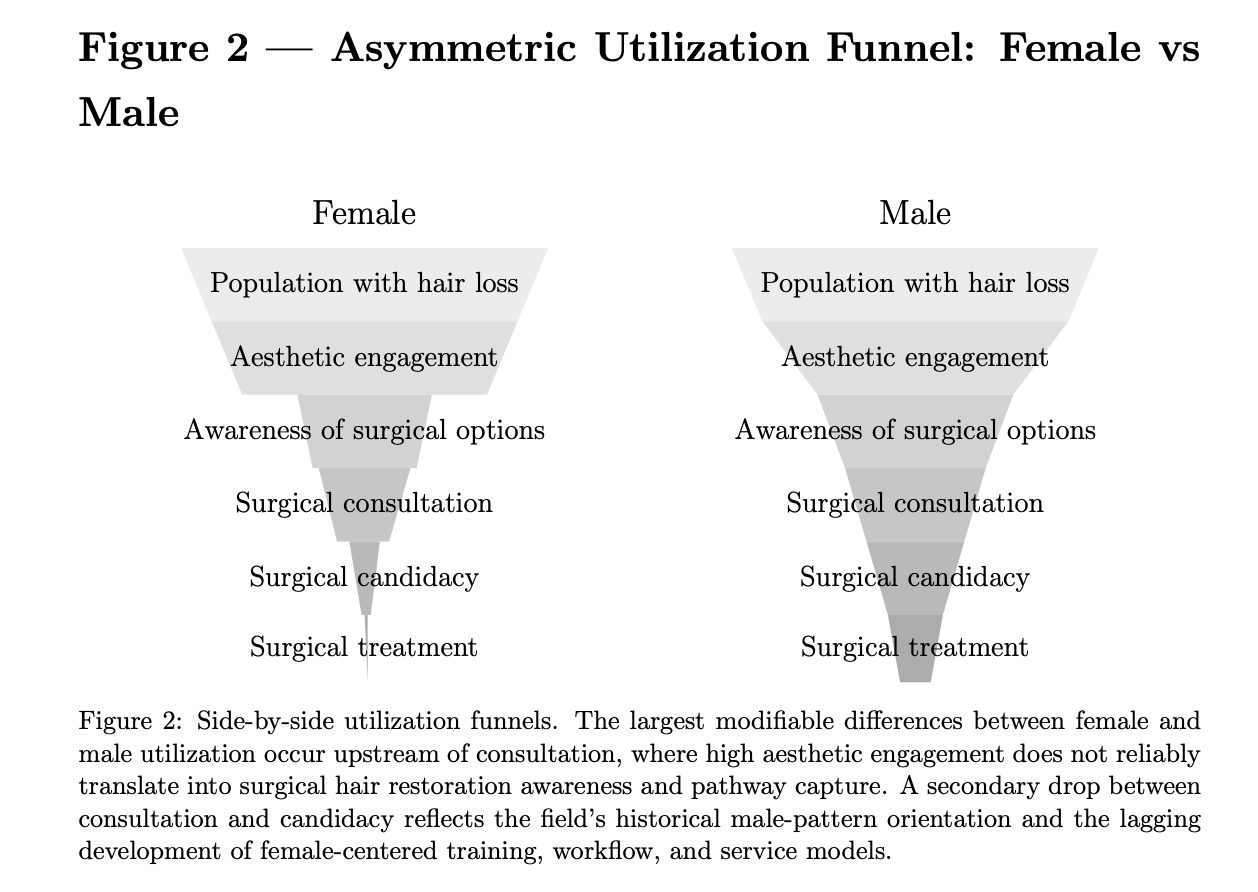
The most significant loss of female patients occurs before surgical consultation. Despite high aesthetic engagement, women are less likely to be exposed to reliable surgical education and referral pathways—creating the largest, most modifiable drop-off in the funnel.
Full White Paper (PDF)
If the embedded PDF does not display on some mobile devices, use the Download button above.