
AlviArmani • Research Institute
Year-over-Year Evolution in FUE Hair Transplant Case Mix, Session Size, Patient Travel Patterns, and Lead-to-Procedure Velocity
A retrospective 2024–2025 internal case analysis examining how AlviArmani U.S. FUE procedure patterns evolved across graft-volume distribution, high-density session share, destination patient patterns, and lead-to-procedure timing.
Summary
This paper compares AlviArmani U.S. FUE case summaries from 2024 and 2025, focusing on procedure size, high-density session share, patient travel patterns, and the interval from lead creation to booked procedure date.
The analysis found a year-over-year shift toward larger single-session FUE procedures, including higher average, median, and modal graft counts, an increased share of procedures exceeding 3,000 grafts, and improved lead-to-procedure velocity. The paper emphasizes that interpretation of larger FUE sessions should remain grounded in donor preservation, patient selection, graft protection, and long-term aesthetic planning. The analysis also serves as a research-level synthesis of the separate 2024 and 2025 AlviArmani FUE statistics reports, linking year-specific case observations into a broader practice-evolution framework.
Key Takeaways
- Larger sessions became more common: the 2025 distribution shifted toward higher graft-volume bands, with the ≥3,500-graft band becoming the largest reported category.
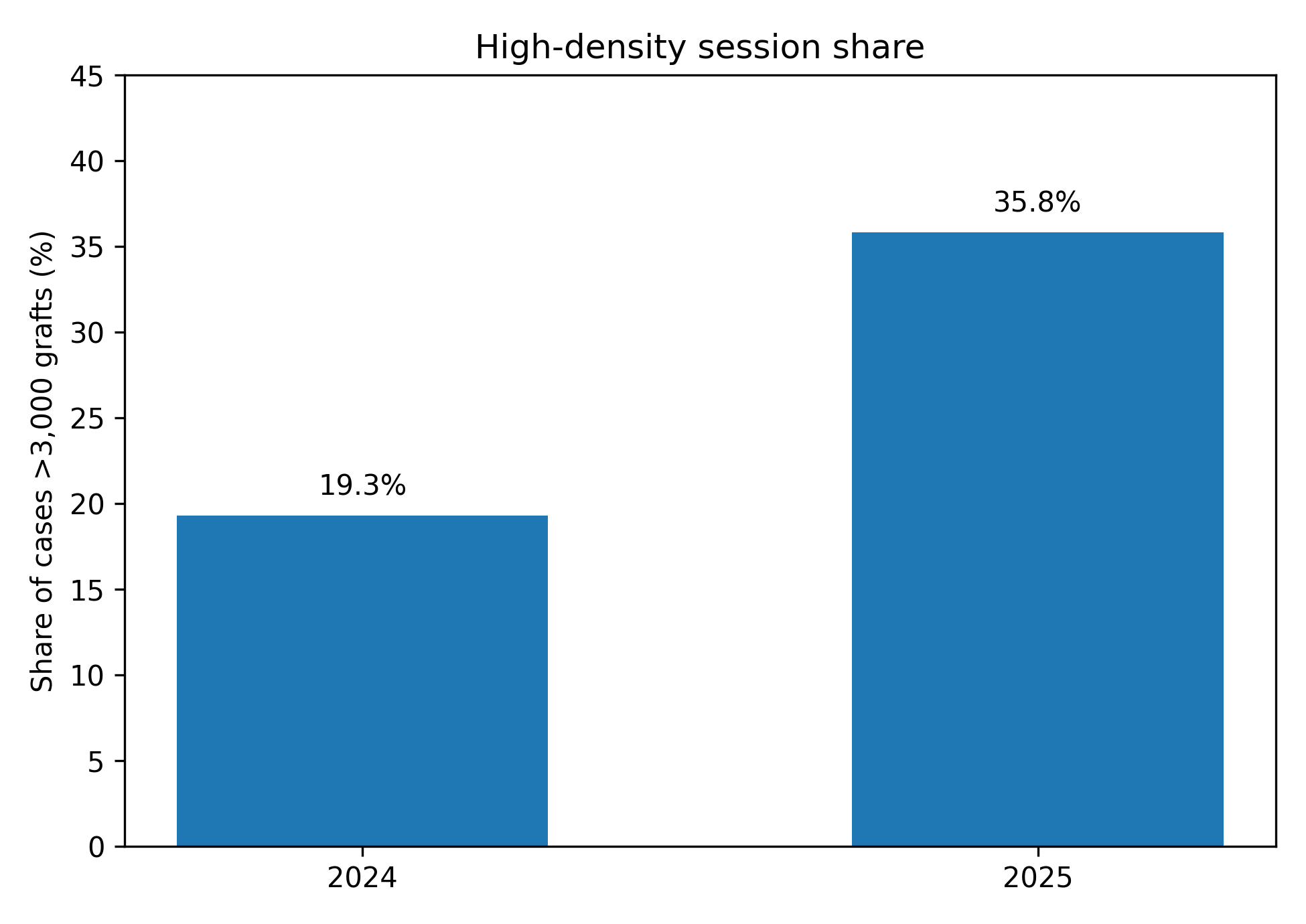
- High-density case share increased: cases exceeding 3,000 grafts rose from approximately 19.3% in 2024 to approximately 35.8% in 2025.
- Booking velocity improved: median lead-to-procedure timing decreased from approximately 52 days to 39 days.
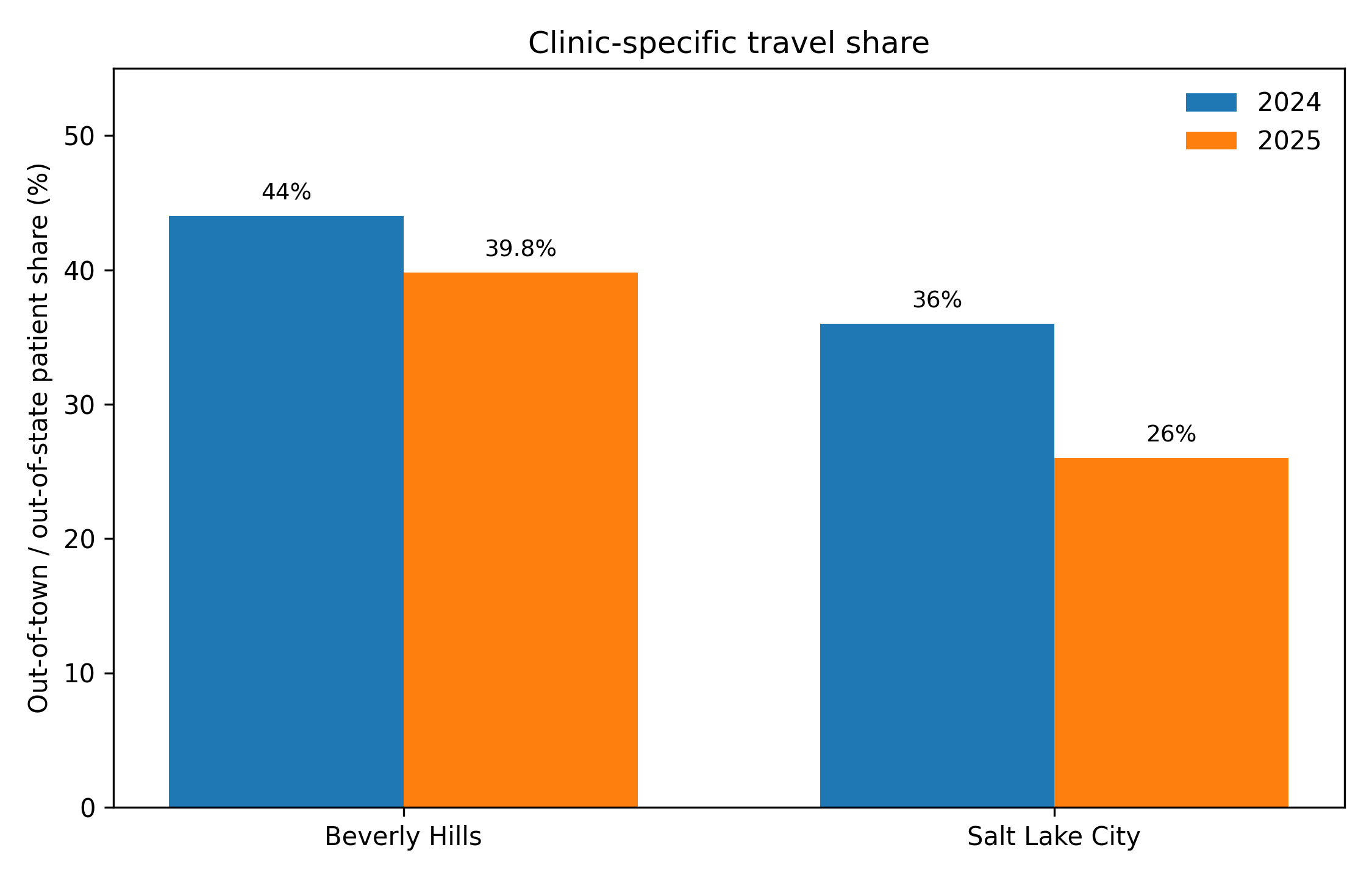
- Travel demand remained meaningful: Beverly Hills retained a stronger destination profile, while Salt Lake City remained positioned as a regional Mountain West hub.
Who This Is For
- Patients: to understand how case planning, procedure scale, and travel patterns are evaluated in a modern FUE practice.
- Clinicians: to review internal practice-level trends in session size and procedural planning context.
- Research readers: to examine how operational metrics may reflect patient demand and practice maturation.
- Consultation teams: to frame larger case planning responsibly, without reducing FUE planning to graft numbers alone.
Interpretation
This is a retrospective internal case and operational analysis, not an independently validated clinical outcomes trial. The paper does not report graft survival analysis, complication rates, blinded photographic scoring, or standardized patient-reported outcomes. Larger FUE sessions should be interpreted through individualized donor assessment, surgical planning, recipient-site strategy, graft handling, and long-term design.
Selected Figures

Figures in the Full Paper
The full PDF also includes the graft-volume distribution by year and a conceptual FUE workflow context figure. Separate image URLs were provided for the high-density session share, lead-to-procedure velocity, and travel-share figures.
Clinical and Operational Context
Larger Sessions Require Planning Discipline
The paper frames larger FUE session size within the established need for donor-resource management, graft handling, extraction pattern control, recipient-site design, and long-term planning. The trend is presented as a practice-level shift, not as a recommendation that larger procedures are appropriate for every patient.
Velocity May Reflect Process Maturity
The improved lead-to-procedure interval may reflect clearer education, stronger follow-up systems, patient confidence, and more coordinated consultation-to-booking workflows. The paper appropriately treats velocity as an operational signal rather than a direct clinical outcome measure.
Bi-Regional Practice Model
The Beverly Hills and Salt Lake City data are interpreted as complementary practice functions: Beverly Hills as a higher-destination-intensity clinic and Salt Lake City as a regional access hub with meaningful inbound demand from nearby Mountain West markets.
Common Questions
Does this paper prove that larger FUE sessions produce better outcomes?
No. The paper reports internal case-size and operational trends. It does not independently validate clinical outcomes, graft survival, complication rates, or patient-reported satisfaction.
Does a higher graft count mean every patient should pursue a larger session?
No. Procedure size requires individualized review of hair-loss pattern, donor availability, hair characteristics, medical history, goals, and long-term planning.
What does lead-to-procedure velocity measure?
In this analysis, lead-to-procedure velocity refers to the interval between lead creation and scheduled procedure date, using confirmed dated cases where available.
How should patients use this research?
Patients can use the paper to better understand how practice-level trends are evaluated, but individualized candidacy, procedure type, and graft planning require review by a qualified medical professional.
Related Research & Education
Full Research Paper
If the embedded PDF does not display on some mobile devices, use the Open PDF or Download Paper button above.
Author
Ashkan B. Hayatdavoudi, MD, JD, is CEO and President of AlviArmani, where he leads the organization’s U.S. strategy, research publishing, clinical development, and patient-centered growth initiatives.
This content is intended for educational purposes and does not replace individualized medical advice. Patients should consult a qualified medical professional to discuss diagnosis, treatment options, and candidacy for hair restoration procedures.