
Hair transplant density describes how transplanted follicular units are distributed within a recipient area. It is an important part of hairline restoration, but density cannot be evaluated by graft count alone. Recipient-area size, hairline design, angle, direction, transitions and long-term donor planning all influence how a result appears.
What Does High Density Mean in a Hair Transplant?
Hair transplant density refers to the concentration of transplanted follicular units within a defined recipient area. It is different from the total number of grafts used in a procedure.
For example, the same graft count distributed across a small frontal area represents a different treatment plan than that graft count distributed across the hairline, mid-scalp and crown.
For that reason, a graft number by itself does not tell you how dense a hair transplant will look.
Hair Transplant Density Is Not a Single Universal Number
Density planning varies according to the area being restored and the objectives of the individual procedure. Applying the same density uniformly across every area of the scalp would ignore important differences in anatomy, visibility and long-term planning.
Hair Angle & Direction
The direction and angle of transplanted hairs influence how neighboring hairs overlap and how the restored area appears.
Scalp Visibility
How visible the scalp is through the hair is an important consideration when planning coverage and placement.
Viewing Conditions
Lighting, viewing angle and styling can materially affect how hair density appears in photographs and in person.
Long-Term Planning
Density decisions must also account for available donor resources and the possibility of progressive future hair loss.
Why Density Planning Changes Across the Scalp
AlviArmani uses a zonal approach to treatment planning because the hairline, frontal region, mid-scalp, crown and temporal areas have different visual and anatomical requirements.
Frontal Hairline
The frontal hairline is highly visible and frames the face. Position, contour, angle, direction and the transition into existing hair all contribute to the result.
Frontal Core & Mid-Scalp
These areas connect the frontal hairline with the posterior scalp and require a balance between coverage, visual density and the available graft supply.
Crown
The crown has a different growth pattern and may require different planning because of its surface area, natural swirl pattern and donor requirements.
Temples & Transition Areas
Temporal and transition areas require careful attention to direction, angle and gradual blending with surrounding hair.
Density Is Only One Part of Hairline Design
The frontal hairline is one of the areas where density is most visible, but simply placing more grafts does not define a successful hairline.
Hairline position, contour, direction, temporal framing and the transition between transplanted and existing hair must work together with the density plan.
Density Within a Vitruvian FUE™ Treatment Plan
Density planning is incorporated into the broader treatment strategy for Vitruvian FUE™. The objective is not to maximize a single density number across the scalp, but to allocate available grafts according to the patient's treatment areas, existing hair and restoration goals.
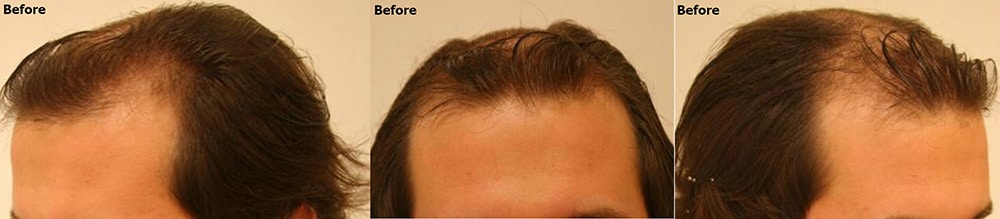
3,200-Graft Hairline, Temple & Frontal Restoration
The patient shown below underwent a 3,200-graft hair transplant to restore the hairline, temples and frontal region. The legacy case record describes the treatment as a high-density, dense-packing approach.
This case provides visual evidence of one patient's treatment strategy. It does not establish a universal graft count or grafts-per-square-centimeter target for other patients.

How to Evaluate Hair Transplant Density in Before-and-After Photos
Hair transplant photographs should be evaluated as evidence, not simply by whether the hair appears thick in a single image. Lighting, viewing angle, styling and scalp visibility can all affect the apparent density of a result.
When possible, compare multiple views and look at the relationship between the restored hairline, the area behind it and the patient's existing native hair.
the plan
More Grafts Does Not Automatically Mean a Better or Denser Result
Hair transplant density must be considered together with treatment-area size, hairline design, graft distribution, hair direction, existing native hair and long-term donor planning.
The appropriate strategy is therefore patient-specific. A density plan that makes sense for a focused frontal restoration may not be appropriate for a procedure covering several larger scalp zones.
Frequently Asked Questions About Hair Transplant Density
What does hair transplant density mean?
Hair transplant density describes the concentration of transplanted follicular units within a defined recipient area. It is different from the total number of grafts used in the overall procedure.
Is graft count the same as hair transplant density?
No. The same number of grafts can represent very different density plans depending on how large an area is being treated and how those grafts are distributed.
Is higher density always better?
No. Density has to be balanced with treatment-area size, available donor resources, existing native hair, hair direction and long-term planning.
Is the same density used across the entire scalp?
Not necessarily. Hairline, frontal, mid-scalp, crown, temporal and transition areas have different planning considerations.
How many grafts were used in the patient example on this page?
The documented patient example used 3,200 grafts to restore the hairline, temples and frontal region.
What was the exact graft density in that 3,200-graft case?
The available case record does not provide a measured grafts-per-square-centimeter value, so an exact density number is not assigned to the case.
How many grafts would I need for a high-density result?
There is no universal graft number. The appropriate graft count depends on the size and location of the treatment area, existing native hair, donor resources, hair characteristics and the goals of the individual procedure.
Learn More About Hairline Design, FUE and Patient Results
Your Hair Restoration Plan Is Individual
Graft count is only one part of planning. Your hair-loss pattern, treatment areas, existing native hair, donor resources and long-term goals all influence the appropriate approach.