
Hair Transplant Results: How to Evaluate Before and After Photos
Patient Education
Hair Transplant Results: How to Evaluate Before and After Photos
Hair transplant results can be one of the most important tools when choosing a surgeon or clinic. Before and after photos allow you to compare hairline design, hair density, naturalness, and what may be possible with modern hair restoration.
But not all result photos are equally useful. Lighting, camera angle, styling, hair length, wetness, and image selection can dramatically change how a result appears.
The better question is not simply whether someone has more hair. The better question is whether the result looks natural, age-appropriate, well-planned, and believable in real life.
The Layered Evaluation Method
The best way to evaluate hair transplantation surgical technique is to move in layers. Do not start by zooming in, counting individual hair follicles, or judging visual density alone.
Start the way people experience a face in real life: from a normal social distance. Then evaluate the procedure context. Then zoom in to study angles, direction, density, and natural asymmetry. Finally, when available, use a comb-through video as the ultimate test.
Results are one part of choosing the right physician. For the broader decision, including surgical judgment, donor management, training, graft survival rates, clinical systems, and long-term planning, read our guide to choosing a hair transplant surgeon .
Step-by-Step Review
How to Evaluate Hair Transplant Results
Start With the Whole Face
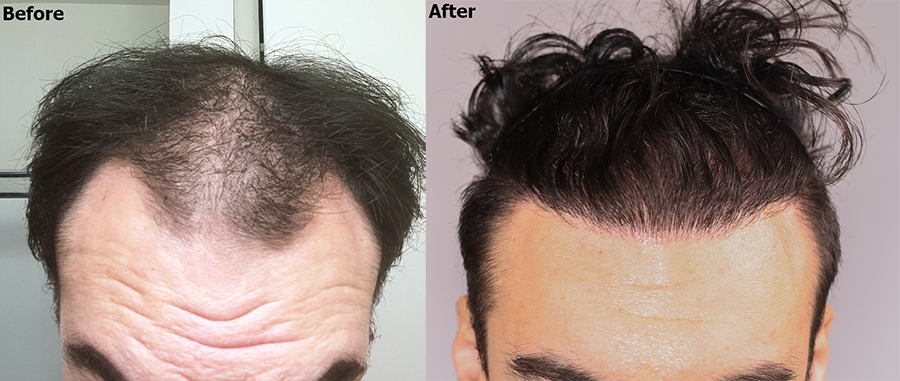
Does the person look natural, balanced, and better than before? A successful result should restore proportion, not simply add new hair.
Look for Natural Asymmetry
Natural hairlines are not perfectly straight or mathematically symmetrical. Look for macro and micro variation that feels organic.
Judge the Clinical Context
A focused frontal case and a larger multi-zone case should not be judged the same way. Density must make sense for the area treated and the donor density available.
Zoom Into the Hairline
Look for soft transition, believable angles, tight but natural spacing, and no obvious rows or harsh wall of hair.
Study Direction and Flow
Transplanted follicles should behave like native hair. The front hairline, temples, mid-scalp, and crown all require different directions.
Use the Comb-Through Test
Still photos matter, but movement reveals whether the result remains natural from multiple angles and under closer inspection.
Step 1
Look at the Whole Face First
More hair is not always the same as a better result. A hair transplant can add density but still fail aesthetically if the hairline does not fit the patient’s facial structure.
A strong hair restoration result should improve facial harmony. It should frame the eyes, balance the forehead, soften recession, and make the patient look more like themselves. Key factors:
- Does the hairline fit the face?
- Does the person look better than before?
- Does the result look natural at a normal social distance?
- Does anything feel too perfect, too low, or too symmetrical?
Step 2
Ask Whether the Result Looks Better — Not Just Fuller
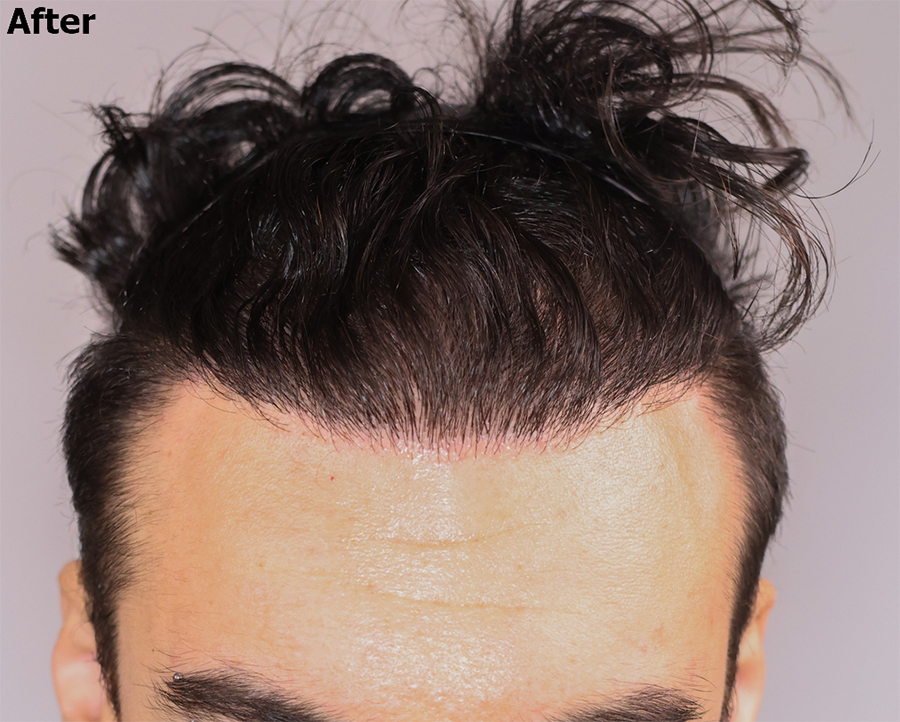
Hair transplant surgery can fill in thinning areas, but the real question is whether the result improves the patient’s appearance. A low, aggressive, or overly symmetrical hairline may create coverage while disrupting facial proportion.
The strongest hair transplant results restore facial framing, improve proportion, and look believable as part of the person’s natural appearance. This is where aesthetic surgery requires restraint and careful planning.
A natural looking hairline is not simply a line of hair follicles. It reflects age, facial dimensions, forehead proportions, temple angles, donor hair quality, donor density, hair shaft caliber, whether the patient has fine hair, and the long-term pattern of hair loss.
Graft count also needs context. The same number of grafts can produce very different visual outcomes depending on the size of the area treated, hair characteristics, density strategy, and donor supply. For a deeper look at how graft requirements are estimated, see our guide to how many grafts you may need for a hair transplant .
Step 3
Look for Natural Asymmetry
Nature is not perfectly even. Faces are not perfectly symmetrical. Hairlines are not perfectly symmetrical. Temple points are not perfectly symmetrical. Even dense, healthy hair has subtle irregularity.
A result that is too straight, too even, or too mathematically perfect can look artificial. A natural hairline should show controlled variation, not randomness.
- Macro asymmetry: larger variation in the hairline shape, temple angles, and frontal contour.
- Micro asymmetry: smaller irregularities at the leading edge of the hairline.
- Look for feathering, softness, small placement variations, and no obvious straight row of grafts.
Step 4
Evaluate the Result in the Context of the Procedure
Hair transplant results should always be judged in the context of the hair transplant procedure. A focused frontal restoration may look denser because the grafts were concentrated. A larger multi-zone restoration may need more grafts to create visual coverage across a wider area.
Donor hair quality, hair shafts, curl, color contrast, the donor area, and the overall extent of hair loss all influence what is possible. Graft survival also affects the final outcome. This is why realistic expectations and treatment planning matter.
- How many grafts were used?
- Which areas were treated: front hairline, frontal zone, mid-scalp, crown, or multiple regions?
- Does the visual density make sense for the number of grafts?
- Was the goal facial framing, full coverage, maximum density, or long-term donor preservation?
- Does the treatment plan account for future hair loss?
Example A
Use Still Images to Move From Full Face to Close Detail
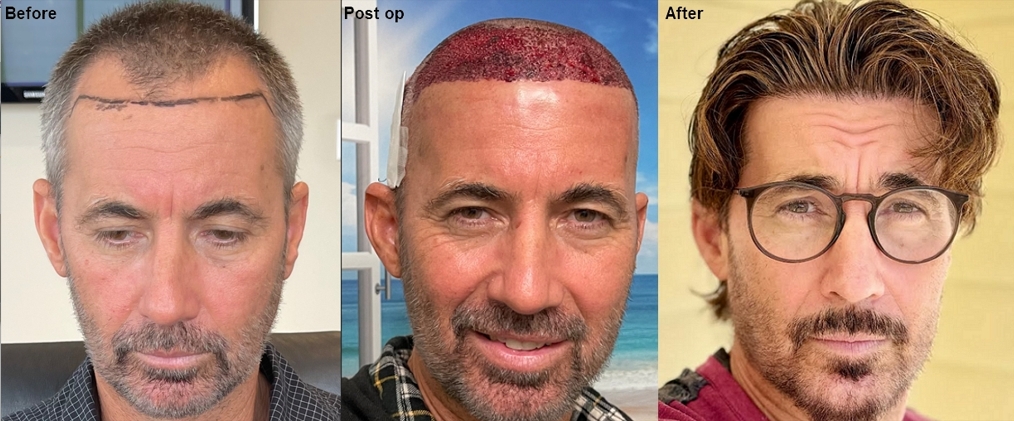
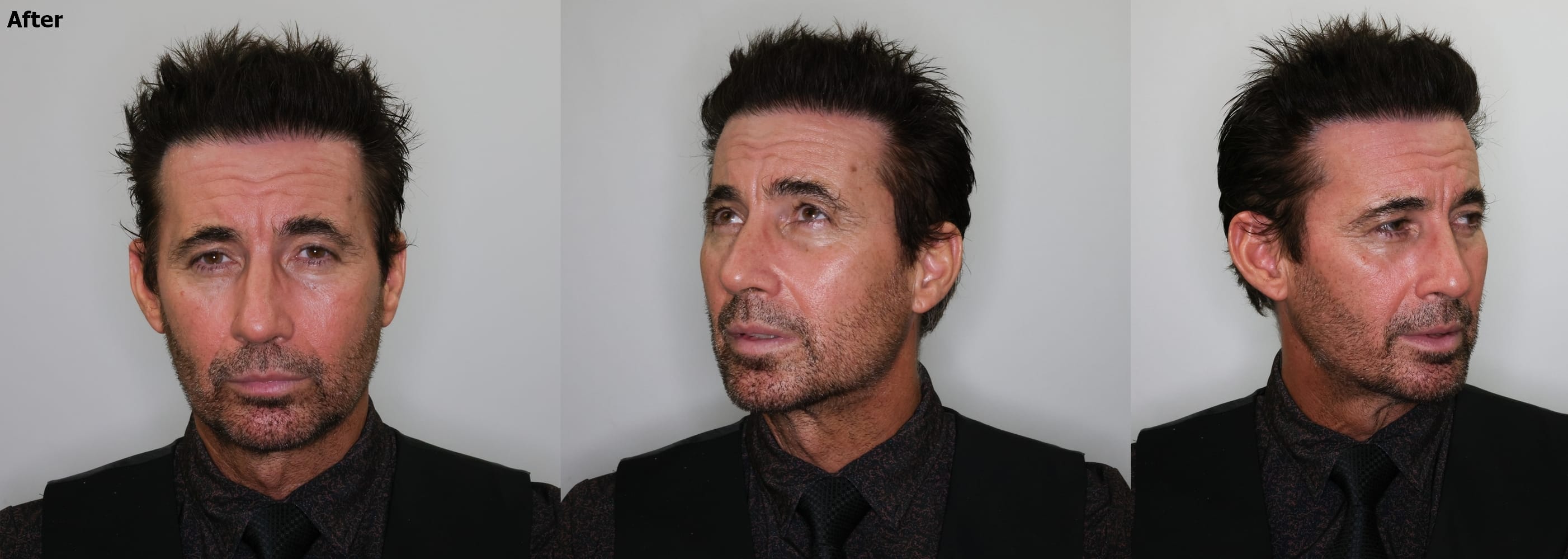
These images belong to one patient example and are included to demonstrate the evaluation procedure. Start with the overall before-and-after comparison, then review the frontal design, and then zoom in on density, direction, and spacing.
Step 5
Zoom In on the Hairline
After the result passes the whole-face test and the context test, zoom in. This is where the surgical technique and technical execution become more visible.
The leading edge of the hairline should not look like a hard wall. It should show softness, natural irregularity, and density that builds behind the front edge.
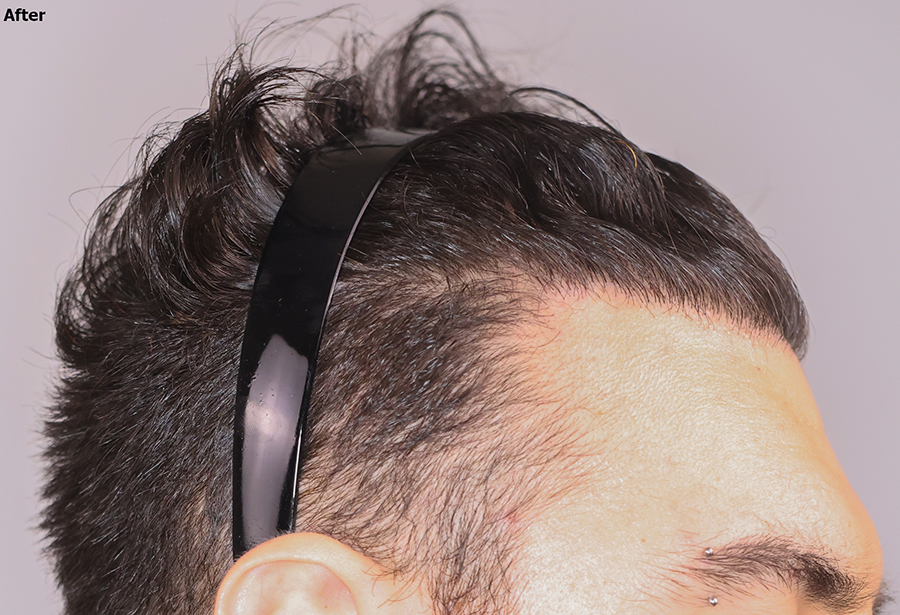
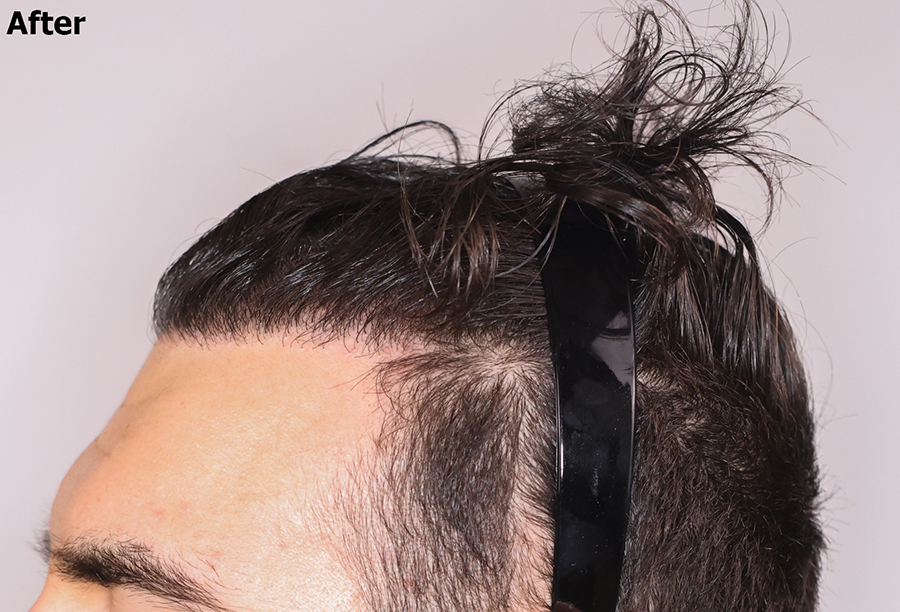
On close inspection, look for natural hair angles, region-specific density, appropriate spacing, subtle asymmetry, and no obvious rows. A natural looking hairline should look grown in, not drawn on.
Step 6
Evaluate Angles, Direction, and Flow
Natural hair transplant results depend on more than density. Hair does not simply grow “up.” Every region of the scalp has its own natural angle, direction, and flow.
In the frontal hairline, hairs often need to exit at low, natural angles. In the temples, direction is especially important. In the crown, the vertex whorl should be respected.
- Do the hairs point in believable directions?
- Does the angle match the surrounding native hair?
- Are the temples too upright or too blunt?
- Does the crown respect the vertex whorl?
- Does density vary naturally by region?
Step 7
Evaluate Hair Density by Region
Hair density should not be identical everywhere. Natural hair does not grow with uniform density across the entire scalp. The frontal hairline, transition zone, frontal core, mid-scalp, and crown each have different visual and anatomical requirements.
The leading edge should be soft. Density often builds behind the hairline. The mid-scalp should transition naturally. The crown usually has a different density pattern because of the whorl and the way light reflects off the scalp.
Good density is not just about packing hair grafts everywhere. It is about density planning and placing density intelligently.
Learn by Restoration Area
Different Areas Require Different Evaluation Standards
Hairline, mid-scalp, and crown results should not be evaluated the same way. Each region has different design priorities, density requirements, and directional patterns.
Hairline Design
Learn how the front hairline frames the face and influences naturalness, proportion, and aesthetic balance.
2Mid-Scalp Strategy
Understand how mid-scalp restoration supports coverage, transition, and the visual bridge between front and crown.
3Crown Design
Review why the crown and vertex require a different approach because of the whorl, direction, and light reflection.
Example B
Use Additional Views to Confirm Consistency
These images belong to a separate patient example. They are included to reinforce the same evaluation process: full visual impression, hairline continuity, close-up density, and natural direction.
Step 8
Understand the Hair Growth Timeline
Hair transplant results develop in distinct stages. Patients may experience shedding or shock loss early in the healing process, followed by early growth and gradual maturation.
New hair growth does not usually appear all at once. Full results and final results can look different from early progress photos as transplanted follicles cycle, strengthen, and mature.
- How many months after surgery was the photo taken?
- Is this early growth or a mature result?
- Has enough time passed to judge final density?
- Were aftercare instructions and scalp care followed during healing?
For a more detailed timeline of healing, shedding, early growth, and post-operative care, see our guide to what happens after a hair transplant .
Step 9
Compare Before and After Photos Under the Same Conditions
After completing the aesthetic and technical review, return to the original before-and-after comparison. Ask whether the photos are truly comparable.
- Are the distance and head position similar?
- Is the lighting similar?
- Is the hair length comparable?
- Is the styling similar?
- Is the hairline exposed in both views?
- Are the wet or dry conditions similar?
If the before photo is harsh and the after photo is polished, the transformation may be harder to judge. The more consistent the photography, the easier it is to trust the result.
Step 10 • The Ultimate Test
The Comb-Through Is the Highest Standard of Result Proof
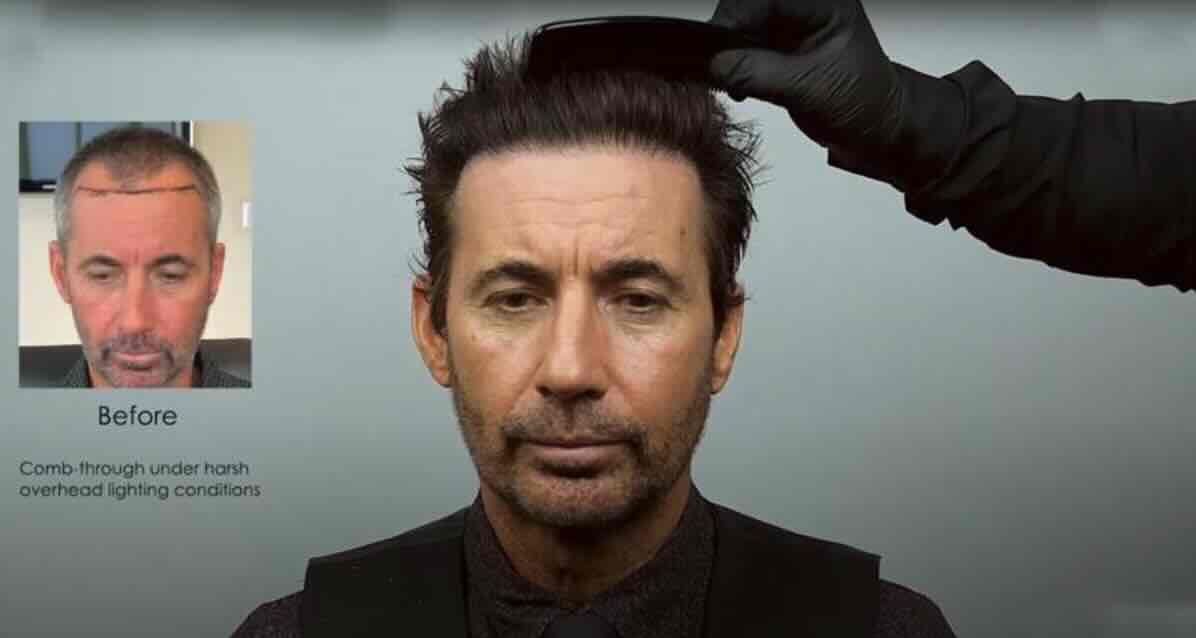
Still photos can be useful, but a comb-through is often the ultimate test of hair transplant results. It shows the hairline in motion, reveals how density behaves when the hair is moved, and makes it harder to hide weak spacing, unnatural angles, or thin coverage.
A strong result should remain believable when the hair is lifted, parted, moved, and viewed from multiple angles. If the result only works in one still image, the documentation is incomplete.
Example A comb-through: review frontal framing, density behavior, movement, and natural appearance from multiple angles.
Example B comb-through: review hair direction, naturalness, density behavior, and whether the result holds up in motion.
Movement
The hair should move naturally and continue to frame the face without looking staged.
Density
A comb-through can reveal whether density holds up when the hair is separated, lifted, or viewed up close.
Direction
The transplanted hair should follow natural direction, flow, and regional scalp patterns.
Transparency
Video makes it harder to rely on one angle, one frame, or one styling position.
Apply the Framework
Evaluate Real Hair Transplant Cases
Use the same framework on documented AlviArmani cases from our Beverly Hills and Salt Lake City surgical teams. Review the overall transformation first, then consider graft count, treatment area, hairline design, density, direction, and the clinical plan behind the result.
2,817-Graft Vitruvian FUE™
Dr. Michelle Ischayek · Beverly Hills
Review a frontal and temporal restoration across Zones 1 and 2,
including the relationship between facial framing, graft distribution,
density, and the patient's existing hair.
2,800-Graft Vitruvian FUE™
Dr. Craig Barton · Salt Lake City
Review a documented Vitruvian FUE™ restoration and apply the same
standards for design, graft distribution, density, direction,
naturalness, and overall facial balance.
Final Review
The Best Results Hold Up at Every Level
A strong hair transplant result should pass the whole-face test, the context test, the zoom test, and the comb-through test.
- From far away, does the result look natural and balanced?
- In context, does the density make sense for the graft count and area treated?
- Up close, do the angles, spacing, asymmetry, and direction look natural?
- In motion, does the result still look believable?
The best result is not always the most dramatic one. It is the one that looks like it belongs to the patient.
FAQ