
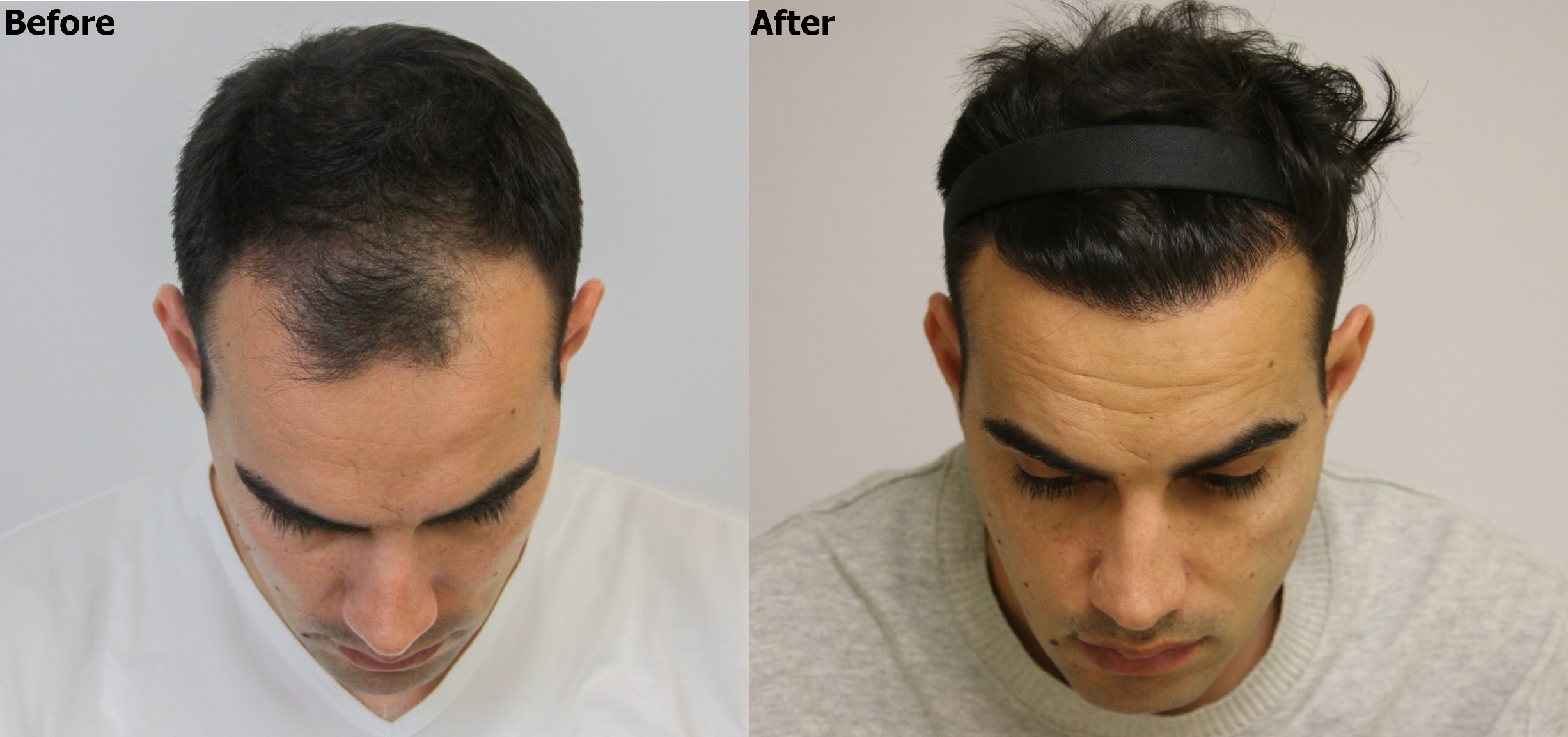
This patient received 2,687 FUE grafts at Alvi Armani Beverly Hills to restore the frontal hairline and adjacent thinning areas. The documented treatment identifies Zones 1 and 2 and includes before, 1-day postoperative and 1-year result photography.
Before, 1 Day Postoperative and 1 Year After 2,687-Graft FUE
This three-stage comparison documents the patient's starting appearance, the recipient area 1 day after surgery and the result at 1 year.
The documented procedure used 2,687 FUE grafts with treatment identified in Zones 1 and 2.

Frontal Hairline and Adjacent Thinning
The treatment plan involved redesigning the patient's frontal hairline and restoring thinning through the adjacent frontal scalp.
The historical case description also refers to restoration extending into the mid-scalp. Because the operative record supplied here specifically identifies Zones 1 and 2, no additional numbered treatment zone is inferred.
2,687 FUE Grafts Directed to Zones 1 and 2
The documented procedure used 2,687 FUE grafts to restore Zones 1 and 2 at Alvi Armani Beverly Hills.
The patient's hairline was redesigned as part of the frontal restoration plan, with treatment extending behind the hairline through the documented recipient area.
Zone 1
The frontal hairline was part of the documented recipient-area treatment.
Zone 2
Treatment extended behind the hairline through the adjacent frontal region.
Top View Before and After Hair Restoration
The top-view comparison provides another perspective on the treated frontal region before and after the 2,687-graft procedure.
Front View Before and After 2,687-Graft FUE
The frontal comparison provides an additional view of the redesigned hairline and treated frontal region.

Zones 1–2
A Mid-2,000-Graft Plan Focused on the Frontal Scalp
This case provides a documented example of 2,687 FUE grafts being used primarily for the frontal hairline and adjacent recipient area.
The before, 1-day postoperative and 1-year sequence is particularly useful because the later result can be compared with direct evidence of the surgical treatment area.
The appropriate graft requirement for another patient depends on recipient-area size, existing native hair, donor resources, hair characteristics and treatment goals.
Why the Day-1 Photograph Is Useful
Postoperative photography helps show where grafts were actually placed before subsequent growth changes the appearance of the recipient area.
Comparing that operative evidence with the documented 1-year result provides more context than viewing the after photograph alone.
Questions About This 2,687-Graft FUE Case
How many grafts were transplanted?
The documented procedure used 2,687 FUE grafts.
Which zones were treated?
The available operative description identifies Zones 1 and 2 as the treated recipient areas.
Was the hairline redesigned?
Yes. Redesign of the frontal hairline is specifically documented as part of this patient's treatment.
Was the mid-scalp treated?
The historical case description refers to restoration of the frontal region and mid-scalp, while the supplied operative description specifically identifies Zones 1 and 2. Without additional operative detail, no separate treatment zone is assigned beyond those documented zones.
Where was the procedure performed?
The case documents treatment at Alvi Armani Beverly Hills.
When was the early postoperative photograph taken?
The early postoperative photograph is documented at 1 day after surgery.
When was the result photographed?
The later result is documented at 1 year after surgery.
Compare More Patient Evidence
Your FUE Hair Transplantation Plan Is Individual
Graft count is only one part of planning. Your hair-loss pattern, treatment areas, existing native hair, donor resources and long-term goals all influence the appropriate approach.