
Temple Angle Closure and Its Role in Facial Symmetry
Hairline Science
Explore the Hairline Design Hub
For a broader look at facial framing, hairline lowering, temple design, and related results, visit the central hairline resource page. Or keep reading to learn about temple angle geometry.
Key Highlights
-
Temple angle closure restores the transition between the frontal and temporal hairline, a region that plays a major role in facial framing.
-
The geometry of the temple angle influences perceived youthfulness, gender expression, ancestry-linked morphology, and facial balance.
-
Temple angle closure should be approached through a proportion-based framework, not a generic filling strategy.
-
Rounded temple angles are generally associated with softness and youthfulness, while sharper temple anglesoften convey structural maturity and masculinity.
-
This technique differs from temple point restoration, which focuses on the smaller pointed lateral tip rather than the broader frontotemporal transition.
-
Natural results depend on precise control of angle, direction, caliber, and density gradient, making temple work one of the most technically demanding areas in hair transplantation.
The frontal hairline often receives the most attention in a hair transplant, but the temple angle plays an equally important role in how the face is framed and how the hairline is perceived overall.

The temple angle is the lateral transition between the frontal hairline and the temporal hairline. When this region recedes, the forehead may appear wider, the upper face may lose continuity, and the hairline may appear more aged or structurally incomplete. For this reason, temple angle closure is not simply a minor refinement. It is a key part of comprehensive temple design.
At AlviArmani, this area is approached within a broader Vitruvian design framework, where hairline architecture is planned according to facial proportion, gender pattern, ancestry-linked craniofacial morphology, and long-term naturalness. In this context, the temple angle is not an isolated corner of the hairline. It is a structural element that helps determine whether the final result appears harmonious or discordant.
For a deeper exploration of this framework, readers should also see our research article on Temple Angle Geometry in Hair Transplantation.
Understanding Temple Angle Closure in Facial Symmetry
In hair restoration, temple angle closure refers to the process of rebuilding the recessed frontotemporal corners of the hairline. This technique helps re-establish continuity between the frontal and temporal hairline and improves the visual architecture of the upper face.
Temple hair loss is one of the most common patterns of hairline change. As the temple angles open, the forehead can appear broader, the face can lose balance, and the overall hairline may seem less youthful. Closing these angles can restore continuity, soften disproportion, and improve facial harmony.
This is why temple angle closure should be understood not merely as adding density, but as restoring one of the defining geometric transitions of the face.
Want to see our research paper on temple angle designs? ->
Definition of Temple Angle Closure
Temple angle closure refers to strategic placement of grafts in the frontotemporal transition zone, where the frontal hairline meets the temporal hairline.
Its objective is to rebuild this angle in a way that is:
-
natural
-
proportionate
-
age-appropriate
-
consistent with the patient’s facial structure and design goals
Depending on the patient, this may involve a softer rounded contour or a more angular and structured transition. The correct choice depends on the broader design plan.
This distinction is important. Temple angle closure is not the same as simply lowering the hairline. It focuses specifically on the lateral architecture of the hairline and the way this architecture influences facial framing.
See our inventory of temple angle closure results ->
Anatomy of the Temple Region and Facial Proportions

The temple area is one of the most important transition zones in facial aesthetics. It links the frontal plane of the forehead with the lateral contours of the face and contributes meaningfully to the appearance of facial width, contour continuity, and upper facial balance.
From an anthropometric standpoint, temple angle planning should be considered in relation to structures such as:
-
glabella–trichion height
-
bizygomatic width
-
bigonial width
-
lateral canthus to temporal hairline distance
These relationships help determine whether temple contour appears balanced within the overall face.
When temple recession occurs, it may produce:
-
excessive visual widening of the forehead
-
loss of continuity across the upper facial third
-
more pronounced lateral recession
-
disruption of overall proportion
This is why the temple angle should be treated as a structural element of hairline architecture rather than a secondary cosmetic detail.
The Role of Temple Angles in Aesthetic Harmony
Temple angle geometry strongly influences how a face is perceived.
Research and clinical observation support that temple contour affects:
-
facial width
-
facial symmetry
-
perceived age
-
gender expression
-
ancestry-linked morphological coherence
In practical terms, the temple angles help determine whether a natural hairline appears youthful or aged, soft or angular, harmonious or incomplete.
A well-designed temple angle can substantially improve the appearance of the face even when a relatively modest number of grafts is used. That is one reason temple refinement often has a disproportionately large aesthetic effect.
How Temple Angles Frame the Face

Temple angles act as the lateral borders of the upper face. They define the transition from the forehead into the sides of the scalp and help frame the eyes, brows, and upper facial contour.
When these angles are preserved or properly restored, they create:
-
a more proportionate upper face
-
a smoother transition from frontal to lateral hairline
-
a stronger sense of continuity in the overall design
When the temples recede, that frame opens. The forehead may appear larger, the face may look less balanced, and the hairline may lose structural cohesion.
Temple angle closure restores this framing effect by rebuilding the frontotemporal contour with carefully directed hair grafts.
Effects on Perceived Facial Symmetry
Temple asymmetry often contributes to broader facial asymmetry more than patients initially realize.
Even modest recession at the corners of the hairline can alter the visual balance between the left and right sides of the face. Excessive bilateral opening can also make the upper face appear disproportionately wide compared with the midface and jawline.
The goal is not rigid mechanical symmetry. Natural faces are not perfectly symmetric. Instead, the objective is perceptual symmetry—a result that appears balanced within the context of the individual patient’s facial architecture.
This principle becomes especially important when planning for long term naturalness.
Temple Angle Closure vs Temple Point Restoration
Temple angle closure and temple point restoration are related but distinct procedures.
Temple angle closure addresses the broader frontotemporal recessions at the upper corners of the hairline.
Temple point restoration focuses on the smaller triangular projection of hair just anterior to the sideburn.
Because they affect different parts of the temporal architecture, they are not interchangeable.
Differences in Surgical Approach and Outcomes
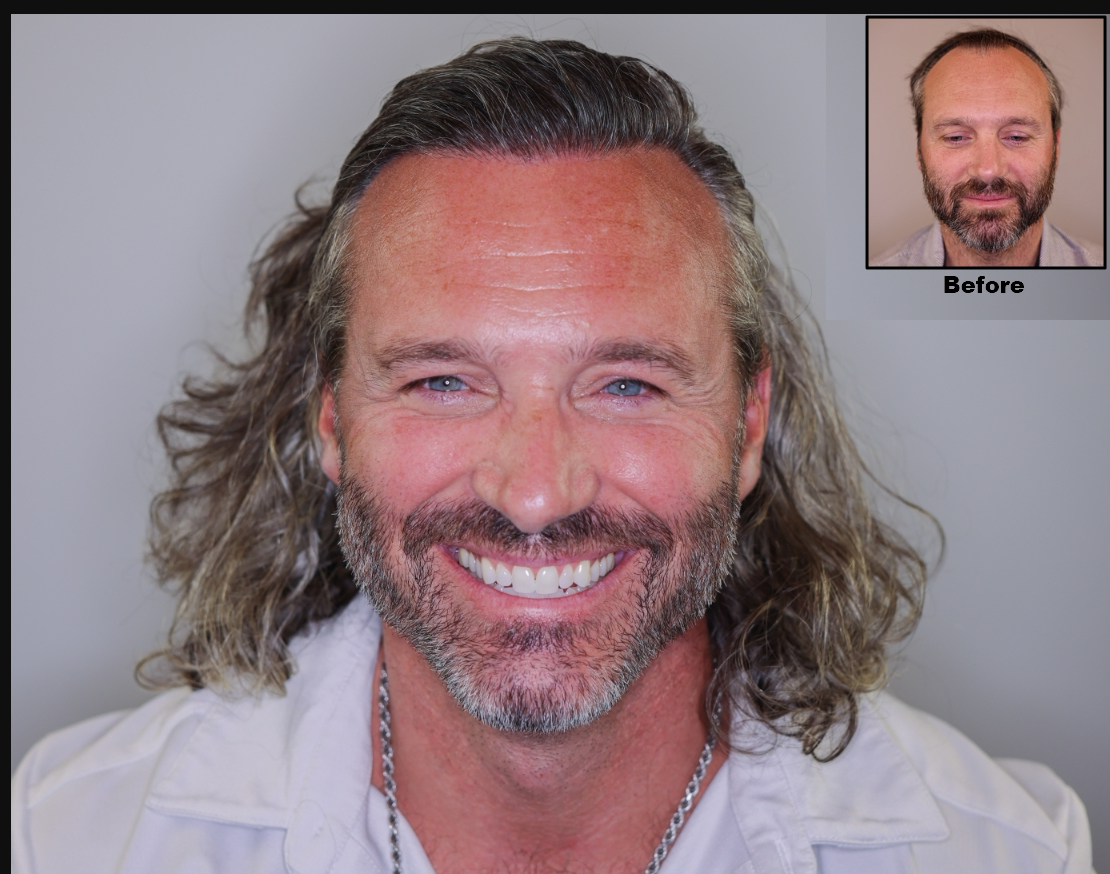
Temple angle closure generally requires broader graft placement across the recessed corners of the frontal hairline. Its main purpose is to restore the lateral frame of the upper face and improve overall contour continuity.
Temple point restoration is narrower in scope. It is used to recreate lateral definition and sharpen the side profile of the hairline.
Quick Comparison
| Feature | Temple Angle Closure | Temple Point Restoration |
|---|---|---|
| Primary Goal | Restore frontotemporal continuity | Recreate lateral temporal point |
| Area Treated | Broad temple recessions | Small triangular lateral point |
| Typical Impact | Strong effect on facial framing | Strong effect on lateral definition |
| Design Focus | Rounded vs sharp angle architecture | Point presence and projection |
In many patients, the most natural result comes from understanding how these two components should relate to one another rather than treating them in isolation.
Rounded vs Sharp Temple Geometry
One of the most important contributions of the AlviArmani research framework is the distinction between rounded and sharp temple angle design.
Rounded Temple Angle
Rounded temple angles typically demonstrate:
-
smoother curvature
-
less pronounced lateral recession
-
greater contour continuity
They are commonly associated with:
-
youthfulness
-
softness
-
femininity
Sharp Temple Angle
Sharp temple angles typically demonstrate:
-
a more angular frontotemporal transition
-
more visible lateral recession
-
stronger structural definition
They are commonly associated with:
-
masculinity
-
maturity
-
stronger facial structure
The Vitruvian Spectrum
The most natural temple angle design usually does not lie at either extreme. Instead, it falls along a Vitruvian spectrum, where curvature and angularity are balanced according to:
-
facial proportions
-
age
-
gender pattern
-
ancestry-linked morphology
-
patient goals
This is a more useful way to think about temple closure than simply asking whether temples should be filled.
Interested in the entire hairline ->
Causes of Temple Angle Imbalance
Temple angle imbalance can arise from multiple causes, including:
-
androgenetic alopecia
-
normal age-related recession
-
trauma
-
traction alopecia
-
scarring
-
inflammatory or autoimmune hair disorders
The most common cause remains androgenetic alopecia, in which inherited sensitivity to DHT leads to progressive follicular miniaturization, often beginning as temple thinning.
Proper diagnosis matters because not all temple loss behaves the same biologically, and not all patients are appropriate candidates for restoration at the same stage.
Assessment and Diagnosis of Temple Angle Asymmetry
Before any temple hair transplant, the surgeon should assess:
-
the stability and pattern of hair loss
-
the degree of temple recession
-
donor supply
-
native hair characteristics
-
facial asymmetry
-
desired aesthetic outcome
This is where the research framework becomes especially useful. The temple angle should be evaluated not in isolation, but in relation to:
-
facial proportions
-
gender pattern
-
age profile
-
ancestry-linked morphology
-
hair characteristics
-
desired framing effect
This broader planning approach helps ensure the final result feels integrated with the rest of the face.
Patients with stable hair loss patterns are typically better candidates for reconstruction in this region, particularly when the design must remain believable over time.
For details see our research paper on temple angle geometry ->
Clinical Examination and Measurement Techniques

Clinical evaluation includes direct examination of the scalp, temple recessions, donor area, and native temporal hair.
The surgeon should assess:
-
recession depth
-
temple angle shape
-
bilateral symmetry
-
forehead height
-
facial width relationships
-
density gradient needs
The quality of available donor hair is especially important in temple work, where the wrong caliber or direction can compromise the final result.
Modern Imaging for Precise Analysis
High-magnification scalp imaging and digital assessment can improve planning by helping evaluate:
-
shaft caliber
-
miniaturization patterns
-
donor quality
-
native density
-
recipient area requirements
This is particularly important in temple work, where even small errors in density, angle, or caliber become visible quickly. At this time, high magnification loops remain the gold standard.
Techniques for Achieving Natural-Looking Temple Angle Closure
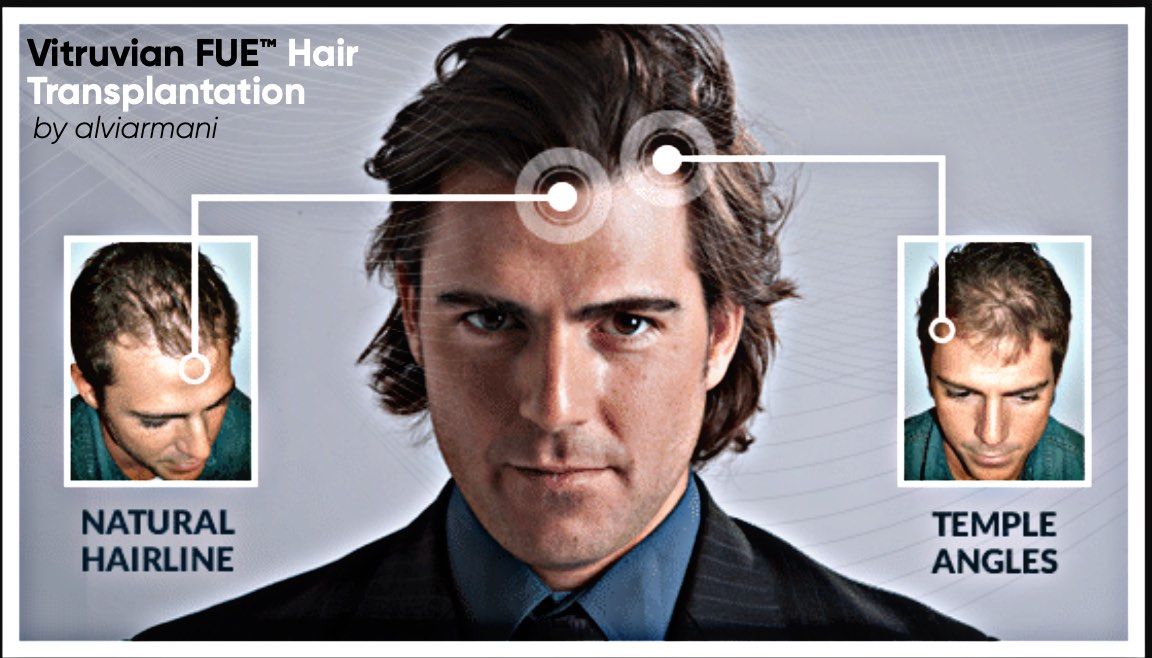
Temple angle closure is one of the most technically demanding areas in hairline transplant planning.
The surgeon must recreate:
-
very acute exit angles
-
correct directional flow
-
appropriate density gradients
-
fine caliber matching
-
natural irregularity
The technical difficulty of this work is one reason many providers avoid temple hair restoration entirely. The margin for error is low, and even minor mistakes may be visible because of the exposed nature of the region.
Read about what goes into a natural hairline design ->
Key Surgical Methods for Temple Angle Correction
Successful temple angle closure depends on several core technical principles.
Directional Micro-Placement
Temple hair must be placed to replicate native directional flow and swirl behavior.
Acute Angle Implantation
Temple hairs emerge at extremely shallow angles. Failure to match these acute exit angles creates an unnatural appearance.
Density Gradient Engineering
Density should generally remain lower laterally and increase gradually as the design moves medially toward the frontal hairline.
Caliber Matching
Finer grafts are essential in the temple region. Coarse hairs at the edge can make the result look harsh.
Irregular Edge Construction
A natural transition should not look geometric or plug-like. Micro-irregularity is necessary for a convincing natural look.
Hair Transplantation Strategies for Temple Angles
Modern temple angle closure is commonly performed with follicular unit extraction, often through a refined FUE hair transplant approach, because it allows careful selection of finer follicles and precise graft-by-graft placement.
This is especially important because temple restoration often requires:
-
small caliber grafts
-
single-hair follicles
-
delicate directional control
-
meticulous spacing
Temple work is not simply about filling a recession. It is about rebuilding a transition zone that behaves like native hair and integrates seamlessly with the broader hairline architecture.
Importance of Temple Angle Geometry in Hair Restoration
Temple angle geometry may be the most important variable in temple reconstruction.
The chosen angle influences:
-
whether the face appears softer or more angular
-
whether the result reads as youthful or mature
-
whether the design appears gender-congruent
-
whether the restored hairline looks anatomically believable
The AlviArmani framework places clinically planned temple angulation along a reference range rather than a rigid formula, generally recognizing that many designs fall somewhere between approximately 85° and 120° relative to the frontal hairline vector, depending on patient characteristics.
These are not fixed rules. They are reference ranges within a proportion-based system.
For readers who want the full framework, anthropometric ranges, and clinical algorithm, this article should directly link to Temple Angle Geometry in Hair Transplantation.
Avoiding Common Mistakes During Restoration
Several errors can make temple restoration appear unnatural.
Common mistakes include:
-
overly sharp design in a patient who needs softness
-
excessive lateral density without a gradient
-
incorrect hair direction
-
over-recession from poor proportional judgment
-
use of coarse grafts at the front edge
-
failure to account for future hair loss
Temple reconstruction is visually unforgiving. Even technically small errors can create obvious disharmony because the area is so exposed.
Advantages of Temple Angle Closure for Facial Symmetry
When properly executed, temple angle closure can:
-
reduce perceived facial width
-
improve framing of the upper face
-
restore a more youthful temporal contour
-
improve gender-congruent design
-
increase overall naturalness of the transplant
Because temple contour contributes so strongly to facial architecture, even subtle refinement can create a disproportionately large aesthetic improvement.
Enhancement of Facial Balance and Youthful Appearance
Temple recession is strongly associated with aging because it creates temporal opening, upper facial widening, and contour discontinuity.
By restoring this region, a temple transplant can create a more youthful appearance without making the hairline look artificially low or heavy.
The improvement often comes from restoring continuity rather than obvious fullness. This is why temple closure can be such a powerful rejuvenation strategy.
Complementary Procedures and Their Benefits
Temple angle closure may be combined with:
-
temple point restoration, for more lateral definition
-
frontal hairline restoration, when central recession is also present
-
medical therapies, to stabilize progressive loss
-
biologic support strategies, depending on the treatment plan
In selected cases, combined treatment creates a more cohesive overall hairline than isolated temple work.
Conclusion
Temple angle closure is one of the most important yet most underutilized elements of advanced hairline design. The temple angle shapes the transition between the frontal and temporal hairline and influences facial symmetry, perceived age, gender expression, and overall aesthetic harmony.
A proportion-based approach—one that integrates facial geometry, ancestry-linked morphology, age, gender pattern, and technical precision—produces more natural and more believable outcomes than a generic approach to temple filling.
At AlviArmani, this philosophy is reflected in the broader Vitruvian framework for hairline architecture. Temple restoration should therefore be considered not as an optional finishing touch, but as a core structural component of comprehensive hairline design.
For the full evidence-based framework behind this approach, readers should also explore Temple Angle Geometry in Hair Transplantation.
Frequently Asked Questions
What is temple angle closure in hair transplantation?
Temple angle closure is the restoration of the recessed frontotemporal corners of the hairline, helping reconnect the frontal and temporal hairline for a more balanced facial frame.
Is temple angle closure the same as temple point restoration?
No. Temple angle closure treats the broader frontotemporal recession, while temple point restoration focuses on the smaller triangular projection in front of the sideburn.
Why are temple angles important in facial aesthetics?
Temple angles influence facial width, symmetry, age perception, gender expression, and how the upper face is framed. Even small changes in this area can significantly alter overall appearance.
Should temple angles be rounded or sharp?
That depends on the patient. Rounded angles are often associated with youthfulness and softness, while sharper angles often convey maturity and stronger masculine structure. The most natural design usually lies along a balanced spectrum rather than at either extreme.
Why is temple angle closure technically difficult?
Temple hairs require extremely acute placement angles, precise directional control, fine graft selection, and careful density transitions. Small mistakes in this region are highly visible.
Can temple angle closure be combined with other procedures?
Yes. It is often combined with temple point restoration, frontal hairline restoration, or medical therapies that support long-term stability.
The concepts discussed in this article are based on the research framework presented by the AlviArmani Research Institute in the paper “Temple Angle Geometry in Hair Transplantation.”
Part of the Hairline Design series on facial framing, natural hairline creation, temple architecture, and hair restoration planning. Page derivative of original research performed by alviarmani named: "Temple Angle Geometry In Hair Transplantation".