
A 3,500-graft hair transplant can represent very different treatment plans depending on the patient's starting pattern, treatment areas, existing native hair, donor resources and long-term goals. The documented AlviArmani cases below show how approximately 3,500 grafts have been used across frontal, hairline, temple, mid-scalp and selected multi-zone restorations.
What Can Approximately 3,500 Hair Grafts Look Like?
The graft number alone does not determine the appearance of a result. These cases illustrate different ways a similar number of follicular units can be distributed according to the patient's documented treatment plan.
The Same 3,500-Graft Count Can Represent Different Restorations
Two patients can receive approximately 3,500 grafts and have substantially different treatment plans. What matters is not simply the total graft count, but where those grafts were placed and what the surgeon was attempting to restore.
These examples are useful for understanding graft planning, but they do not establish a universal graft requirement. Another patient may require a different number of grafts or a different distribution.
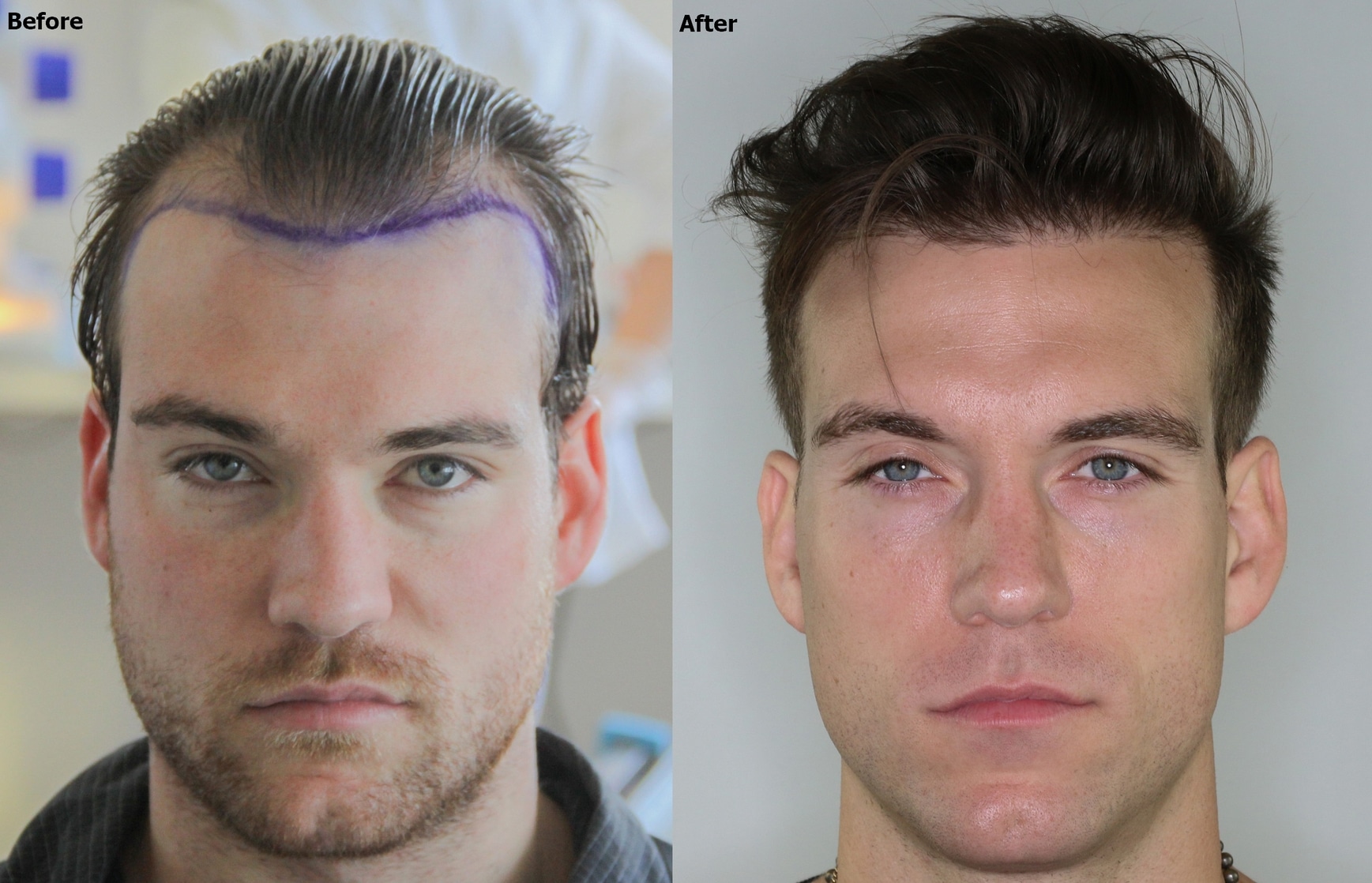
3,500-Graft Full Frontal and Temple Restoration
The original patient documented on this page received 3,500 Vitruvian FUE grafts at AlviArmani Beverly Hills .
The documented starting classification was AlviArmani Pattern 2 Class 5 / Norwood 4. Treatment involved the full frontal region and temples, corresponding to Zones 1 and 2.

Watch the 3,500-Graft Case
How Is Coverage Planned With Approximately 3,500 Grafts?
A graft count is a surgical resource, not a predefined amount of scalp coverage. How approximately 3,500 grafts are used depends on the individual patient's documented starting point and treatment priorities.
Treatment Area Matters
Concentrating grafts within Zones 1 and 2 represents a different treatment strategy from distributing the same number through the frontal region and into the mid-scalp or another documented zone.
Existing Native Hair Matters
The amount and location of existing hair influence where transplanted grafts may be needed. Graft count therefore cannot be interpreted independently of the patient's starting pattern.
Donor Resources Matter
Surgical planning must also account for the patient's available donor resources and the possibility of future hair loss. The appropriate graft number is individualized rather than selected from a standard graft-count chart.
Long-Term Planning Matters
In some patients the priority may be a focused frontal restoration. In others, the treatment plan may extend farther posteriorly or may be considered within a staged long-term strategy.
Result Timing Matters When Comparing 3,500-Graft Cases
The cases in this group were not all photographed at the same point after surgery. Some provide earlier follow-up evidence, while others document results at approximately one year or another later interval.
An earlier postoperative image should not be interpreted in the same way as a later result. Photography can also differ in lighting, angle, hair length, styling and whether the image was obtained in a standardized clinical setting or submitted by the patient.
For that reason, the strongest comparison considers the starting point, treatment areas, graft count, follow-up interval and quality of the photographic evidence together.
Your Hair Restoration Plan Is Individual
Graft count is only one part of planning. Your hair-loss pattern, treatment areas, existing native hair, donor resources and long-term goals all influence the appropriate approach.